
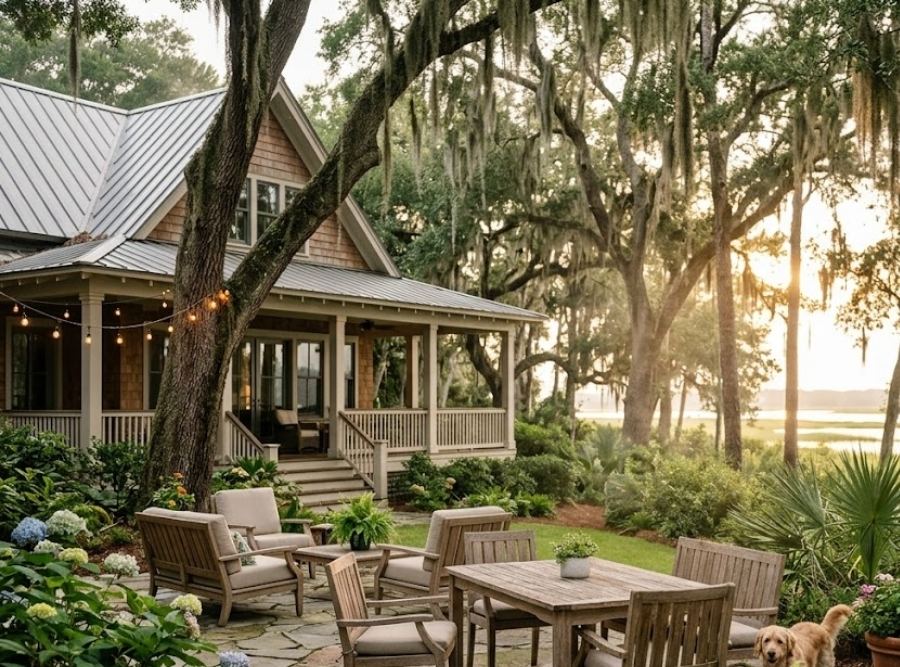
Mosquito season is so severe in the South Carolina Lowcountry because warm temperatures, high humidity, frequent rainfall, marshes, lagoons, and standing water allow mosquitoes to breed for much of the year. While activity usually peaks from late spring through early fall, mosquitoes don’t simply disappear after summer, and in Bluffton they can remain active well into late fall or even year-round during mild winters.
There comes a point almost every year when Bluffton homeowners ask the same question: “Are the mosquitoes worse than usual?” It usually happens after several weeks of afternoon thunderstorms, when stepping onto the patio means hearing the familiar high-pitched buzz before the grill is even turned on. Children come back inside covered with bites after only a few minutes of playing, pets constantly swat at insects while walking through the yard, and outdoor dinners become a race against sunset. For many residents, it feels like mosquito season arrives overnight and refuses to leave.
The truth is that mosquito season isn’t just a seasonal inconvenience in the Lowcountry, it’s the result of an environment that naturally supports mosquito populations better than almost anywhere else in the Southeast. Bluffton’s combination of coastal humidity, mild winters, marshes, retention ponds, wooded preserves, heavy summer rainfall, and rapidly growing neighborhoods creates nearly continuous opportunities for mosquitoes to breed. Understanding why they’re so persistent helps explain why they seem impossible to avoid and why effective mosquito control requires much more than spraying the insects flying around your backyard.
The Lowcountry Is Almost Designed for Mosquitoes
One of the biggest misconceptions homeowners have is believing mosquitoes come primarily from the marsh. While tidal marshes certainly contribute to regional mosquito populations, they tell only part of the story. The mosquitoes biting you during an evening cookout may have developed much closer to home than you realize.
Mosquitoes need surprisingly little to complete their life cycle. After a female mosquito lays her eggs in standing water, larvae hatch and remain in the water while they develop. Depending on temperature, some species can complete that entire process in less than two weeks. Once they emerge as adults, they immediately begin searching for cool, shaded places to rest during the day before becoming most active around dawn and dusk.
Bluffton provides nearly everything mosquitoes need to repeat that cycle over and over again. Afternoon thunderstorms refill breeding sites throughout the summer. Warm temperatures allow rapid development. High humidity helps adult mosquitoes survive longer without drying out. Dense landscaping, live oak canopies, shrubs, and ground cover create shaded resting areas where mosquitoes avoid the midday heat before becoming active each evening.
We often remind homeowners that mosquitoes don’t need large ponds to become a problem. A forgotten flowerpot saucer, clogged gutter, children’s toy holding rainwater, decorative planter, bucket, or section of tarp can hold enough water for hundreds of mosquito larvae to develop. When those small breeding sites exist across an entire neighborhood, mosquito populations grow much faster than most people expect.
Why Bluffton’s Climate Extends Mosquito Season
Many parts of the country experience a hard winter freeze that dramatically reduces mosquito activity. Bluffton rarely has that advantage. While colder temperatures may temporarily slow mosquito populations, extended freezing weather is uncommon, allowing many mosquito species to remain active much later into the year than homeowners from northern states expect.
Mosquito activity generally begins increasing as temperatures consistently warm during spring. By late spring and early summer, breeding accelerates rapidly because rainfall, humidity, and warm evenings all become more favorable. The combination of repeated thunderstorms and consistently warm nights creates ideal breeding conditions throughout much of the summer, allowing new generations of mosquitoes to emerge after nearly every significant rainfall.
This is one reason homeowners often feel like mosquito treatments “stopped working” after a storm. In reality, heavy rain frequently creates dozens of new breeding sites throughout the surrounding area. While an individual property may be maintained carefully, mosquitoes developing on neighboring lots, nearby drainage systems, retention ponds, wooded areas, or unmanaged containers can quickly replace those that were previously controlled.
Even as autumn arrives, mosquito season doesn’t end overnight. Warm days continue well into the fall across the Lowcountry, and adult mosquitoes remain active whenever temperatures allow. Mild winters may reduce activity considerably, but they rarely eliminate mosquitoes entirely. That’s why longtime Bluffton residents often describe mosquito season as something that fades gradually rather than ending on a specific calendar date.
Rain Doesn’t Create Mosquitoes—It Creates Opportunity
After almost every period of heavy rain, we receive questions from homeowners wondering why mosquitoes suddenly seem twice as bad. The timing makes perfect sense once you understand how mosquito populations develop.
Rainfall itself doesn’t produce mosquitoes. Instead, it creates the standing water mosquitoes need to reproduce. Every afternoon thunderstorm leaves behind dozens of temporary water sources that may last long enough for eggs to hatch and larvae to mature. Areas that appeared completely dry one day may suddenly provide ideal breeding habitat only hours later.
One important detail many people overlook is that the water doesn’t have to remain for very long. During warm Bluffton weather, mosquito development happens remarkably quickly. A container that collects rainwater over the weekend may produce adult mosquitoes before many homeowners even realize water is still standing there. Repeated summer storms restart this process again and again, making mosquito populations feel relentless throughout the season.
Heavy rain also changes mosquito behavior after they emerge. Damp soil, increased humidity, and cooler evening temperatures improve survival while encouraging mosquitoes to search actively for blood meals. At the same time, lush vegetation holds moisture longer after storms, creating shaded resting areas where adult mosquitoes remain protected during daylight hours. By the time evening arrives, large numbers of mosquitoes are already waiting beneath shrubs, ornamental grasses, decks, and tree canopies before beginning to feed.
Why Some Bluffton Neighborhoods Feel Much Worse Than Others
One question we hear regularly is why one neighborhood seems overrun with mosquitoes while another only a few miles away appears much more comfortable. The answer usually comes down to the surrounding environment rather than any one individual property.
Many of Bluffton’s master-planned communities were intentionally designed around lagoons, retention ponds, golf courses, preserved wetlands, wooded buffers, and extensive landscaping. These features contribute to the beauty of neighborhoods such as Hampton Lake, Hampton Hall, Berkeley Hall, Belfair, Rose Hill, Palmetto Bluff, and communities throughout the New Riverside corridor, but they also create environments where moisture remains available for much longer than in open, less vegetated areas.
Homes bordering marshes, wooded preserves, drainage swales, or large water features often experience longer periods of mosquito activity because adult mosquitoes don’t travel randomly. They seek shaded vegetation during the day and remain close to reliable moisture sources whenever possible. Even neighborhoods with excellent maintenance programs may still experience seasonal mosquito pressure simply because the surrounding environment naturally supports larger populations.
We’ve also noticed that newer developments sometimes experience heavier mosquito activity during their early years. Fresh landscaping requires regular irrigation, nearby construction may temporarily alter drainage, and surrounding undeveloped property can continue producing mosquitoes until additional phases of construction are completed. As neighborhoods mature and drainage patterns stabilize, mosquito activity often changes, but the coastal climate continues supporting breeding opportunities every year.
Inspector’s Insight: The Backyard Usually Isn’t the Whole Problem
One of the most surprising things homeowners learn during a mosquito inspection is that the mosquitoes biting them aren’t always breeding on their own property. In fact, some of the worst mosquito problems we see occur at homes where the owners have done almost everything right.
Birdbaths are emptied regularly. Gutters are clean. Containers are turned over after rain. Shrubs are trimmed, and standing water has been eliminated wherever possible. Yet every evening, mosquitoes still appear as soon as family members step outside. That doesn’t necessarily mean those efforts failed.
Mosquitoes don’t recognize property lines. A breeding site hidden behind a neighboring fence, water trapped inside an abandoned flowerpot several houses away, clogged community drainage features, retention ponds, marsh edges, wooded preserves, or unmanaged vacant homes can all contribute to the mosquito pressure experienced throughout an entire neighborhood. That’s why effective mosquito management focuses not only on reducing breeding sites but also on managing the adult mosquito population where people actually spend time outdoors.
Understanding that broader picture helps explain why mosquito problems often seem larger than a single backyard. The environment surrounding the property is usually just as important as the property itself, particularly in Bluffton’s coastal landscape where moisture is never far away.
Why DIY Mosquito Solutions Often Provide Only Temporary Relief
Most homeowners don’t ignore mosquitoes. By the time they begin searching for professional mosquito control, they’ve usually tried citronella candles, bug sprays, mosquito coils, Thermacell devices, bug zappers, patio fans, or even yard foggers. Some of these products can certainly make spending time outdoors more comfortable for a short period, but many people become frustrated when the mosquitoes seem to return only a day or two later.
The reason isn’t necessarily that those products don’t work. It’s that most DIY methods focus on the mosquitoes people can see while doing very little to interrupt the mosquito life cycle. Killing adult mosquitoes on the patio this evening doesn’t prevent hundreds of new adults from emerging a few days later if larvae are continuing to develop in standing water throughout the neighborhood. That’s why mosquito populations often rebound so quickly after every period of rain.
Another common mistake is assuming mosquitoes only breed in obvious places like ponds or marshes. In reality, some of the most productive breeding sites are surprisingly small and easy to overlook. Water trapped inside clogged gutters, corrugated drainpipe, children’s outdoor toys, buckets, wheelbarrows, decorative planters, tarps, birdbaths, plant saucers, and even discarded bottle caps can support mosquito development. Homeowners often eliminate one source while several others remain unnoticed around the property or nearby homes.
We’ve also seen well-intentioned homeowners apply mosquito products immediately before a thunderstorm, unknowingly reducing their effectiveness before they have an opportunity to work. Successful mosquito management isn’t simply about applying a product, it’s about understanding timing, weather, breeding cycles, and the environment that’s supporting the population.
Why Mosquitoes Always Seem Worse at Sunset
Many people notice they can work in the yard during the afternoon with very few mosquitoes, only to feel like they’re being attacked the moment the sun begins to set. That isn’t your imagination. It’s a reflection of mosquito biology.
During the hottest part of the day, mosquitoes avoid direct sunlight because heat and dry conditions increase the risk of dehydration. Instead, they rest beneath dense shrubs, ornamental grasses, ground cover, tree canopies, crawlspace openings, decks, and other cool, shaded areas where humidity remains higher. As temperatures begin to fall in the evening, they become much more active and start searching for blood meals.
This explains why families often say they can mow the lawn during the afternoon but can’t enjoy dinner on the patio afterward. Outdoor kitchens, pools, fire pits, screened porches with open doors, and backyard entertaining spaces naturally become gathering places for people just as mosquitoes become most active. Carbon dioxide from breathing, body heat, and movement all help mosquitoes locate potential hosts, making evening outdoor activities particularly attractive to them.
Bluffton’s humidity makes this even more noticeable. Calm evenings following afternoon rainstorms often produce ideal conditions for mosquito activity because moisture remains trapped beneath vegetation while temperatures stay warm enough for prolonged feeding. Homeowners frequently describe this as the time when they “can’t even grill outside anymore,” and it’s one of the most common reasons people finally decide something needs to change.
Does Mosquito Season Ever Really End in Bluffton?
One of the most searched questions every year is, “When does mosquito season end?” The answer depends less on the calendar and more on the weather.
In many northern states, prolonged freezing temperatures dramatically reduce mosquito activity for several months. Bluffton rarely experiences those extended freezes. Instead, mosquito populations gradually rise during spring, reach their highest levels throughout summer, remain active well into the fall, and then decline as cooler weather becomes more consistent. During particularly mild winters, mosquitoes may still be seen on warmer afternoons even in months many people would consider “off season.”
That doesn’t mean every month experiences the same level of mosquito pressure. Late spring through early fall is typically when homeowners notice the greatest impact because rainfall, humidity, and temperatures consistently favor rapid breeding. Tropical systems, hurricane season, and repeated afternoon thunderstorms can temporarily increase activity even further by creating countless new breeding sites throughout the region.
Rather than thinking of mosquito season as having a clear beginning and end, it’s more accurate to think of it as a cycle that expands and contracts throughout the year. Some years, an unusually wet spring starts the season earlier. Other years, a warmer-than-average autumn extends mosquito activity well beyond what homeowners expect. That’s one reason mosquito control programs are often adjusted according to seasonal conditions rather than relying on fixed calendar dates.
Why Professional Mosquito Control Looks Beyond Your Lawn
One of the biggest differences between temporary mosquito relief and long-term mosquito management is understanding how mosquitoes use an entire property rather than focusing on one location. An experienced inspection begins by identifying where mosquitoes are breeding, where they’re resting during the day, and where people spend the most time outdoors.
Standing water receives immediate attention because interrupting the mosquito life cycle is one of the most effective ways to reduce future populations. At the same time, shaded vegetation, dense shrubs, ornamental grasses, tree lines, fences, crawlspace entrances, and areas beneath decks are evaluated because adult mosquitoes commonly shelter there before becoming active each evening.
Just as importantly, the inspection considers environmental factors beyond the individual property. Nearby retention ponds, marsh edges, drainage swales, wooded preserves, lagoons, irrigation systems, and neighborhood landscaping all influence mosquito pressure. A single backyard doesn’t exist in isolation, particularly in Bluffton’s master-planned communities where water features and preserved green space are common.
This broader perspective is why one treatment alone rarely solves an entire season’s mosquito problem. Mosquitoes are continually emerging from new breeding sites after rain, and adult populations are constantly moving throughout the surrounding environment. Long-term management combines source reduction, property evaluation, and appropriately timed treatments that work together instead of relying on one temporary solution.
Inspector’s Insight: The Best Mosquito Control Starts Before You Notice Mosquitoes
One pattern we’ve seen repeatedly throughout Bluffton is that homeowners often wait until mosquitoes have already made the backyard unusable before taking action. By then, multiple breeding cycles may already have occurred, allowing populations to build week after week.
The most successful mosquito management programs usually begin before mosquito numbers reach their seasonal peak. Early inspections identify drainage concerns, clogged gutters, irrigation problems, hidden standing water, and dense vegetation while mosquito populations are still relatively manageable. Addressing those issues early often reduces the explosive population increases that occur later in the summer.
We’ve also learned that homeowners sometimes become discouraged because they continue seeing a few mosquitoes after treatment. That’s understandable, but it’s important to remember that no property exists inside a protective bubble. Bluffton’s environment continually produces mosquitoes from surrounding marshes, wetlands, wooded areas, retention ponds, and neighboring properties. The objective isn’t creating a backyard where mosquitoes can never fly through again. The goal is reducing mosquito activity enough that families can comfortably enjoy their outdoor spaces without feeling like they’re constantly being chased indoors.
Enjoying the Lowcountry Doesn’t Have to Mean Accepting Mosquitoes
Living in Bluffton means enjoying beautiful marsh views, mature live oaks, lush landscapes, outdoor entertaining, and long evenings spent outside with family and friends. Those same natural features also help create one of the longest mosquito seasons in the Southeast. While that reality can’t be changed, the impact mosquitoes have on your property often can.
Understanding why mosquitoes thrive in the Lowcountry is the first step. Warm temperatures, humidity, rainfall, standing water, and shaded vegetation all contribute to mosquito populations, but those conditions don’t automatically mean your backyard has to become unusable every summer. Reducing breeding sites, improving drainage, managing vegetation, and taking a proactive approach to mosquito control can make a significant difference throughout the season.
If mosquitoes are keeping your family from enjoying the patio, pool, outdoor kitchen, or backyard, Mr. Pest Control can help identify why mosquito pressure is so high around your property and recommend a treatment plan based on your home’s specific environment. Our goal isn’t simply to spray mosquitoes you happen to see today, it’s to reduce the conditions that allow new generations of mosquitoes to keep replacing them all season long.

Joe Duncan is the owner of Mr. Pest Control, a family-owned pest control company that has served Bluffton, SC and the surrounding Lowcountry since 1955. As the third generation to run the business, Joe and his crew provide residential and commercial pest control, termite control, mosquito treatment, and bed bug services throughout Beaufort and Jasper County, SC. He’s built the company’s reputation on straightforward, no-nonsense service backed by a money-back guarantee.