
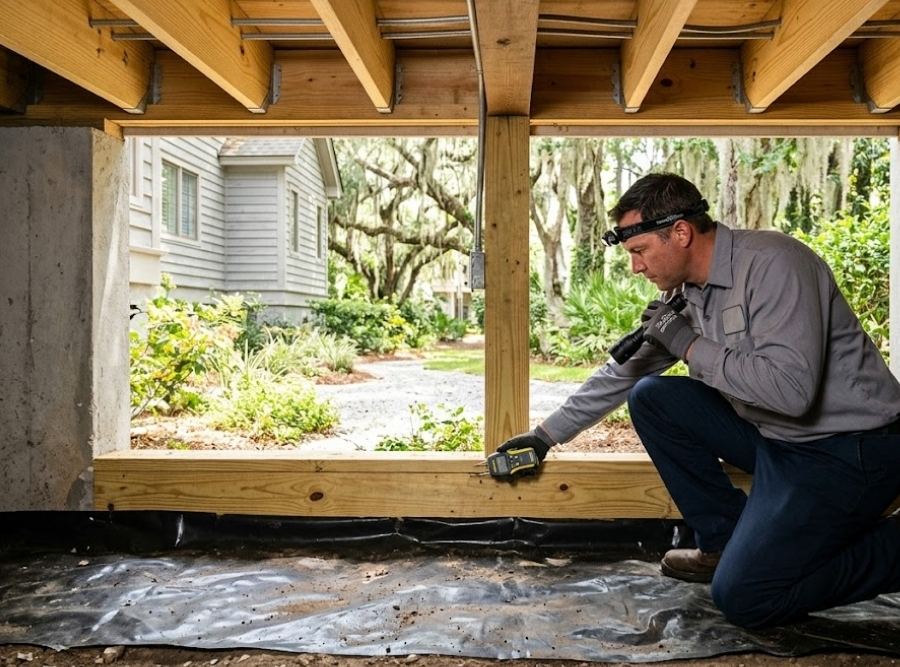
A CL-100 inspection is South Carolina’s official Wood Infestation Report that documents visible evidence of termites, other wood-destroying organisms, wood decay fungi, and conditions that could lead to wood damage. If you’re buying, selling, or refinancing a home in Bluffton, your lender or real estate transaction may require a CL-100, but it’s also a valuable inspection for homeowners who want to identify termite or moisture issues before they become expensive structural problems.
Buying or selling a home in Bluffton involves several inspections, reports, and documents, and one of the most misunderstood is the CL-100. Many buyers first hear about it from their Realtor or lender just days before closing, while homeowners searching online often wonder whether it’s simply another name for a termite inspection. Others assume it replaces a home inspection or guarantees the house is completely free of termites. Those misunderstandings are incredibly common, but they can also lead to unnecessary stress during an already busy real estate transaction.
The truth is that a CL-100 serves a very specific purpose. It helps document the visible condition of a home’s structural wood with respect to termites, other wood-destroying organisms, wood decay fungi, and conditions that may contribute to future problems. In Bluffton, where warm temperatures, coastal humidity, crawlspaces, heavy rainfall, and marsh-influenced moisture create ideal conditions for subterranean termites, understanding what a CL-100 does and what it doesn’t do is just as important as the inspection itself.
A CL-100 Is More Than a “Termite Letter”
One of the biggest misconceptions we hear is someone saying, “I just need a termite letter for closing.” While people often use terms like termite certificate, termite clearance letter, or wood infestation report interchangeably, a CL-100 is much more specific than simply confirming whether termites are present.
A CL-100 is South Carolina’s official Wood Infestation Report. During the inspection, a licensed pest management professional examines accessible areas of the property for visible evidence of active or previous infestation by wood-destroying organisms, including subterranean termites, powderpost beetles, and certain wood-destroying fungi. The inspection also documents visible conditions that increase the likelihood of future wood damage, such as excessive crawlspace moisture, poor drainage, wood-to-soil contact, or structural areas that cannot be fully inspected because access is limited.
That distinction matters because a CL-100 is designed to document observable conditions at the time of the inspection. It is not predicting what may happen years from now, nor is it certifying that termites could never be present somewhere hidden inside the structure. Instead, it provides an accurate assessment of what can be seen, allowing buyers, sellers, lenders, and homeowners to make informed decisions based on the property’s current condition.
This is why experienced inspectors spend far more time evaluating the environment than simply searching for live termites. The goal isn’t just finding insects. It’s understanding whether the home shows evidence of conditions that termites or wood-destroying organisms are likely to exploit.
Why Bluffton Homes Commonly Need CL-100 Inspections
If you were buying a home in a dry climate with long, cold winters, termite inspections might not carry the same importance. Bluffton presents a completely different environment. The Lowcountry’s climate naturally creates conditions where moisture and termites often go hand in hand, making routine inspections far more valuable than many homeowners initially realize.
Subterranean termites require moisture to survive. Bluffton’s year-round humidity, warm temperatures, heavy afternoon rainstorms, marsh-adjacent neighborhoods, high groundwater levels, and irrigated landscapes provide exactly the environment they prefer. Homes throughout communities such as Hampton Hall, Rose Hill, Belfair, Berkeley Hall, Hampton Lake, New Riverside, Shell Hall, and neighborhoods surrounding the May River frequently include crawlspaces where moisture management becomes an important part of protecting structural wood.
Even homes that appear perfectly maintained from the outside may have elevated crawlspace humidity beneath them. Plumbing leaks, damaged vapor barriers, inadequate drainage, or irrigation keeping soil consistently damp can increase wood moisture levels long before homeowners notice anything unusual inside the living space. In many cases, termites are responding to those moisture conditions rather than simply choosing one house over another.
We’ve inspected homes where the owners were completely surprised by the findings because nothing inside the house suggested a problem. Floors looked level, walls appeared normal, and no insects had been seen indoors. Once the crawlspace was evaluated, however, elevated moisture, early fungal decay, or termite activity became visible. Structural wood often tells the story long before cosmetic finishes do.
What Does a CL-100 Inspector Actually Look For?
Many homeowners picture a termite inspector walking around the house searching for insects. While termites are certainly part of the inspection, that’s only one piece of the overall evaluation. An experienced CL-100 inspection is much more methodical because termites are often hidden inside structural wood, beneath flooring systems, or within crawlspaces where they remain unnoticed for years.
The inspection typically begins by evaluating accessible structural components that support the home. Crawlspaces receive particular attention because they contain floor joists, sill plates, support beams, rim joists, subflooring, plumbing penetrations, vapor barriers, foundation walls, piers, and other areas where moisture-related problems often develop first. Inspectors are looking not only for active termites but also for mud tubes, previous damage, wood decay, fungal growth, excessive humidity, water intrusion, and conditions that make future infestation more likely.
One of the most important concepts homeowners should understand is the difference between evidence and conditions. Finding active termites is evidence of an infestation. Finding wood in direct contact with damp soil or a crawlspace with consistently high moisture may not indicate termites today, but those are conditions that significantly increase future risk. Both are important because preventing termites often begins long before termites are actually discovered.
This is one reason experienced inspectors don’t rush through crawlspaces. A small plumbing leak beneath a bathroom may seem unrelated to termites at first, but persistent moisture can gradually raise the moisture content of nearby framing. Wood decay fungi may begin developing first, followed by termite activity months or years later if the underlying moisture problem remains unresolved. Understanding that sequence allows homeowners to address the cause instead of waiting for structural damage to appear.
A CL-100 Is Not the Same as a Home Inspection
Perhaps the most common misunderstanding during a real estate transaction is assuming the home inspector will automatically perform the CL-100. Although both inspections may occur around the same time, they serve entirely different purposes and are completed by different licensed professionals.
A home inspection provides a broad evaluation of the property’s overall condition. Roofing, HVAC systems, plumbing, electrical components, appliances, windows, insulation, and many other systems are visually assessed to identify defects or maintenance concerns. While a home inspector may notice signs that suggest termite damage or moisture problems, their inspection is not intended to replace South Carolina’s official Wood Infestation Report.
The CL-100 focuses specifically on visible evidence of wood-destroying organisms, wood decay fungi, and conditions conducive to infestation. That specialized focus allows the inspector to spend considerably more time evaluating structural wood components, crawlspaces, moisture conditions, and other areas directly related to wood deterioration. Rather than competing with a home inspection, the two inspections complement one another by examining different aspects of the property.
Think of it this way. A home inspection helps you understand the overall health of the house. A CL-100 helps you understand the condition of the wood structure and whether termites, decay, or moisture have affected it. Together, they provide a much more complete picture than either inspection could provide on its own.
Inspector’s Insight: Moisture Usually Tells the Story Before Termites Do
One of the biggest lessons we’ve learned from inspecting Bluffton homes is that termites rarely appear without a reason. While homeowners understandably focus on the insects themselves, experienced inspectors often spend just as much time following moisture as they do looking for termites.
In Bluffton’s coastal environment, persistent crawlspace humidity is often the first warning sign that something deserves closer attention. A torn vapor barrier, poor drainage after heavy rains, irrigation spraying against the foundation, or a slow plumbing leak may quietly keep structural wood damp enough for months before any cosmetic changes appear upstairs. By the time soft flooring, sticking doors, or bubbling paint become noticeable, the underlying conditions may have existed for a long time.
That’s why a CL-100 isn’t simply about finding termites today. It’s also about recognizing the conditions that allow termite activity and wood deterioration to develop tomorrow. Addressing moisture early often protects far more than the crawlspace, it helps preserve the structural integrity of the entire home.
Can a House Pass a CL-100 If It Has Old Termite Damage?
One of the questions that creates the most anxiety during a real estate transaction is whether previous termite damage automatically means the house will “fail” a CL-100 inspection. The short answer is no. A home can have evidence of previous termite activity and still receive a satisfactory report, provided there is no visible active infestation or unresolved conditions that require correction under the report’s findings.
This is where many homeowners confuse old damage with active termites. Structural wood doesn’t repair itself after termites are eliminated, so evidence of previous activity may remain visible for years. An experienced inspector looks for signs that help distinguish historical damage from an active problem. Active subterranean termites often leave fresh mud tubes, live insects, or evidence that feeding is continuing, while older damage may simply reflect a problem that was properly treated in the past.
We’ve inspected many Bluffton homes where buyers became alarmed after hearing the words “termite damage,” only to discover the damage had already been treated years earlier and no active infestation was present. That doesn’t mean the damage should be ignored, but it does illustrate why proper interpretation matters. A CL-100 is intended to document what is visible at the time of the inspection, allowing everyone involved in the transaction to understand the home’s current condition rather than making assumptions based on its history.
Previous termite treatment records, repair documentation, and termite bond information can also provide helpful context. While those records don’t replace the inspection itself, they often help explain why older evidence exists and whether appropriate corrective action has already been taken.
What Happens If a CL-100 Identifies Problems?
Many people casually say a house “failed” the CL-100, but that’s not really how the inspection works. A CL-100 isn’t graded like a school exam with a simple pass-or-fail score. Instead, it documents visible findings that may need to be addressed before a lender, buyer, or seller is comfortable moving forward with the transaction.
Sometimes the findings are relatively minor. An inspector may identify excessive crawlspace moisture caused by poor grading, recommend replacing a damaged vapor barrier, or note wood-to-soil contact that should be corrected to reduce future termite risk. In other situations, active termite activity, wood decay fungi, or damaged structural framing may require treatment, repairs, or additional evaluation before closing can proceed.
The response depends on the nature of the findings and the terms negotiated between the buyer and seller. In many Bluffton transactions, repairs are completed before closing so the property can be reinspected and the updated documentation provided to the lender. Other situations may involve repair credits or negotiated agreements, depending on the purchase contract and lender requirements.
One reason experienced professionals recommend scheduling the inspection well before closing is that unexpected findings almost always require coordination. Pest treatment companies, contractors, Realtors, lenders, and inspectors may all need time to complete their part of the process. Waiting until the final week before closing can create unnecessary stress when solutions often require only a little additional time.
Does a CL-100 Guarantee There Are No Hidden Termites?
This is perhaps the single biggest misunderstanding surrounding CL-100 inspections, and it’s important to answer clearly.
A CL-100 does not guarantee that a home has never had termites or that termites could never be present somewhere concealed within inaccessible areas of the structure. Like many professional inspections, it is based on visible and accessible conditions at the time the inspection is performed. For example, inspectors cannot see inside finished walls, beneath permanently installed flooring, behind cabinets, or within structural areas that are inaccessible without destructive investigation. If those areas cannot be examined, they cannot honestly be represented as termite-free. Rather than making promises no inspection could realistically support, the CL-100 documents what is observable while noting areas that may have limited accessibility.
That limitation shouldn’t be viewed as a weakness of the inspection. Instead, it’s part of maintaining professional accuracy. A trustworthy inspection explains what was observed, identifies conditions that deserve attention, and avoids making guarantees that no one could verify without dismantling portions of the home.
For homeowners, the practical takeaway is simple. A clean CL-100 is valuable because it documents that no visible evidence was found during the inspection, but ongoing termite protection and routine inspections remain important, particularly in Bluffton’s climate where termite pressure never truly disappears.
Do New Construction Homes Need a CL-100?
Another common misconception is that only older homes require CL-100 inspections. While new construction homes generally haven’t had decades to develop moisture or termite issues, they aren’t automatically exempt from termite pressure simply because they’re recently built.
As we’ve discussed in other articles, construction itself changes the surrounding environment. Clearing land, disturbing soil, installing irrigation, and developing entire neighborhoods can alter termite movement throughout an area. Newly completed homes may also experience settlement, landscaping changes, drainage adjustments, or moisture conditions that weren’t present when construction was first completed.
Whether a new home requires a CL-100 often depends on the circumstances of the transaction. Some lenders require one before closing, while some buyers request the inspection simply because they want independent documentation of the property’s condition. Even when not required, many homeowners appreciate having a professional baseline that documents the visible condition of the structural wood early in the home’s life.
Rather than assuming new construction eliminates termite concerns, it’s more accurate to recognize that every home in Bluffton exists within an environment where termites naturally occur. Age changes the types of issues inspectors commonly find, but it doesn’t eliminate the importance of understanding the home’s condition.
Why Waiting Until Closing Week Can Create Problems
One pattern we’ve seen repeatedly is homeowners discovering they need a CL-100 only after their lender or closing attorney requests it. Suddenly, what seemed like a routine document becomes one more deadline competing with appraisals, insurance paperwork, final walk-throughs, and moving schedules.
If the inspection identifies active termites, elevated crawlspace moisture, damaged framing, or repairs that require additional evaluation, the closing timeline can quickly become more complicated. Treatment may need to be completed, repairs scheduled, and a follow-up inspection performed before updated documentation can be issued. None of those steps are necessarily difficult, but they do require time.
Scheduling the inspection earlier in the transaction provides flexibility. Buyers gain a clearer understanding of the property’s condition, sellers have time to address concerns if necessary, and lenders receive the documentation they require without creating last-minute pressure. Even when the report reveals no significant issues, having that information early often makes the remainder of the transaction smoother for everyone involved.
Protecting Bluffton Homes Beyond the Real Estate Transaction
Although CL-100 inspections are commonly associated with buying and selling homes, their value extends well beyond closing day. Many homeowners don’t think about termites again until they see swarmers, discover mud tubes, or notice soft flooring years later. Unfortunately, termites don’t wait for another real estate transaction before continuing their work.
Bluffton’s climate creates conditions where regular monitoring is simply good home maintenance. Crawlspaces should be checked periodically for standing water, plumbing leaks, damaged vapor barriers, excessive humidity, and wood-to-soil contact. Gutters and downspouts should move water away from the foundation, irrigation should avoid saturating the soil beside the home, and vegetation should be kept from trapping unnecessary moisture against structural components.
One of the most effective ways to reduce long-term termite risk is addressing moisture before termites ever become part of the conversation. Dry structural wood is far less attractive than damp framing exposed to consistent humidity. That simple principle explains why experienced inspectors spend so much time evaluating drainage, ventilation, crawlspace conditions, and water management instead of focusing exclusively on insects.
Routine termite inspections also provide the opportunity to identify changes while they’re still relatively small. A plumbing leak discovered early is far easier to repair than years of hidden moisture damage. A localized termite treatment is far less disruptive than replacing structural floor framing after prolonged infestation. Prevention almost always costs less than repairing advanced damage.
Understanding the Purpose of a CL-100 Helps You Make Better Decisions
A CL-100 inspection isn’t simply another box to check before closing. It’s an opportunity to better understand the condition of one of the most important parts of any home—the structural wood that supports it. By documenting visible evidence of termites, other wood-destroying organisms, wood decay, and conditions that encourage future problems, the report provides valuable information that buyers, sellers, lenders, and homeowners can use to make informed decisions.
In Bluffton, where coastal humidity, crawlspaces, frequent rainfall, and year-round termite pressure create unique challenges, that information becomes even more valuable. Understanding the difference between old damage and active infestation, recognizing how moisture influences termite activity, and identifying concerns before they become structural repairs can help protect both the property and the investment it represents.
If you’re buying, selling, refinancing, or simply want a clearer understanding of your home’s condition, Mr. Pest Control can perform a professional CL-100 inspection and explain the findings in clear, practical language. Our goal isn’t simply to complete a report, it’s to help homeowners understand what the inspection means, why the findings matter, and how to protect their homes long after the paperwork is complete.
Joe Duncan is the owner of Mr. Pest Control, a family-owned pest control company that has served Bluffton, SC and the surrounding Lowcountry since 1955. As the third generation to run the business, Joe and his crew provide residential and commercial pest control, termite control, mosquito treatment, and bed bug services throughout Beaufort and Jasper County, SC. He’s built the company’s reputation on straightforward, no-nonsense service backed by a money-back guarantee.