
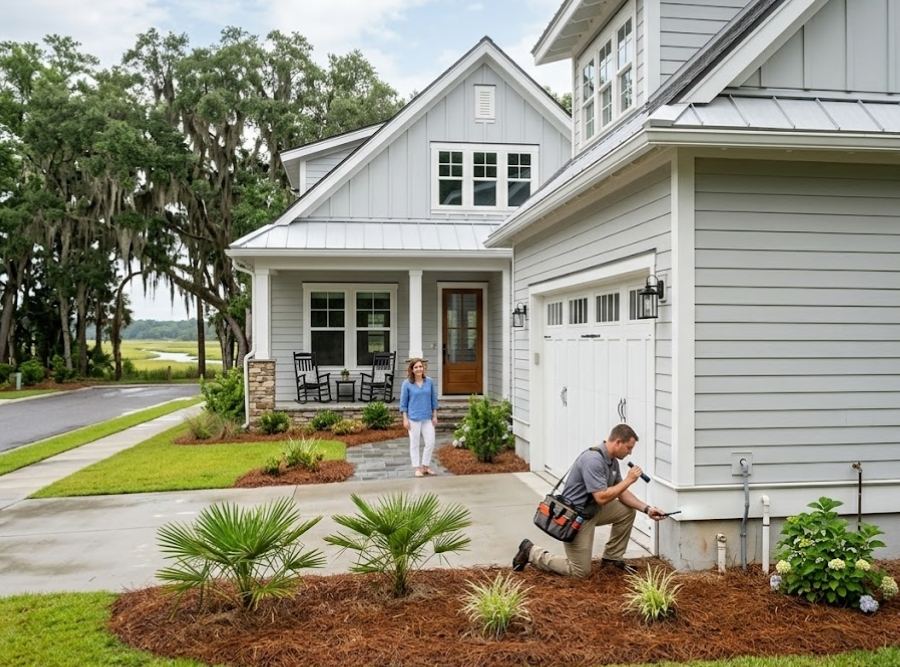
Newer homes in Port Royal can still benefit from preventive pest control because coastal humidity, heavy rain, marshes, fresh landscaping, irrigation, and nearby construction create pest pressure regardless of a home’s age. A new house may have fewer structural gaps than an older historic home, but it is not pest-proof, and early inspection, exclusion, moisture control, and targeted exterior treatment can prevent occasional insects from becoming recurring problems.
A newer home may seem like the last place that would need pest control. The construction is recent, the kitchen is clean, the windows are modern, and the builder may have already arranged termite pretreatment before closing. When ants begin appearing around the sink, palmetto bugs turn up in the garage after rain, or spiders rebuild webs around porch lights every night, many homeowners understandably wonder whether professional service is really necessary or whether the insects will eventually disappear on their own.
The answer depends on what is happening around the home, not simply when the house was built. Newer Port Royal neighborhoods still sit within the same warm, humid coastal environment as the Old Village, waterfront areas, and older communities near Paris Avenue. Marshes, tidal creeks, wooded buffers, wet soil, summer thunderstorms, and mild winters support insect activity throughout much of the year. In many cases, recently developed properties experience additional pressure because grading, construction, fresh mulch, new sod, and irrigation disturb existing pest habitat while creating new places for insects to shelter.
Preventive pest control does not have to mean spraying chemicals throughout the house every month. The strongest approach begins with identifying the pests, correcting moisture and entry conditions, monitoring the structure, and using targeted treatments only where they are needed.
Newer Homes Are Tighter, but They Are Not Pest-Proof
A modern Port Royal home is generally built with tighter windows, improved weather barriers, and fewer age-related gaps than a historic Lowcountry cottage. That can reduce certain entry opportunities, but it does not create a completely sealed structure. Every house still needs doors, roof ventilation, plumbing lines, electrical service, HVAC connections, drainage features, and transitions between different building materials.
Those necessary components create small openings that insects may exploit. Ants can follow plumbing or electrical routes through gaps that are almost impossible to see without close inspection. Palmetto bugs may enter beneath garage doors or worn corner seals, while spiders gather around soffits and porch lights where flying insects are concentrated. Millipedes, earwigs, and other ground-dwelling pests often appear around thresholds after extended rain saturates the soil.
New construction can also contain minor exclusion issues that have nothing to do with serious workmanship failure. A door sweep may not sit evenly against the threshold, weatherstripping can become compressed, or caulking around an HVAC line may leave a narrow opening. Homes settle, landscaping crews work around the foundation, and utility companies may add cables after construction, creating new gaps that were not present during the final walk-through.
One misconception we hear often is that a new house should prevent every insect from entering. In coastal South Carolina, an occasional outdoor invader can still slip inside even when the house is well maintained. The more useful question is whether sightings are isolated or whether insects are repeatedly using the same entry points and finding conditions that allow them to remain.
Construction Can Increase Pest Activity Instead of Eliminating It
Many newer Port Royal homes are built through infill development, redevelopment, or residential growth toward Shell Point, Port Royal Landing, Burton, and the Parris Island Gateway corridor. Before construction begins, those lots may contain established ant colonies, spiders, rodents, termites, cockroaches, and other organisms living beneath vegetation, tree roots, debris, and undisturbed soil. Clearing and grading do not make those populations disappear.
Construction changes where pests live. Heavy equipment removes shelter, utility trenches disrupt underground colonies, and stormwater patterns shift as foundations, driveways, and roads are installed. Pests that once occupied a larger natural area begin searching for stable shelter, and a completed home can quickly become one of the driest and most protected structures nearby.
This pressure may continue even after a homeowner moves in. An empty lot next door may be cleared months later, another phase of development may begin nearby, or new drainage work may disturb insects that had already relocated once. That helps explain why some homeowners see very little activity during the first few weeks and then notice a sudden increase after construction starts elsewhere in the neighborhood.
We often find that the home itself is only part of the story. Ants appearing near one exterior wall may be connected to newly disturbed soil several yards away. Palmetto bugs in the garage may be responding to wet debris and grading on an adjacent property rather than anything inside the house. Looking beyond the lot line is often necessary to understand why pest activity changes so quickly in a developing area.
Fresh Landscaping Creates Shelter Beside the Foundation
New neighborhoods usually receive new sod, mulch, pine straw, ornamental shrubs, irrigation systems, and drainage features soon after construction. These improvements make the property look finished, but they also create moisture and shelter that insects naturally use. The issue is not that landscaping causes pests by itself; it is that the way landscaping is installed and maintained can concentrate them close to the home.
Fresh mulch and pine straw retain moisture after rain and irrigation. Ants establish colonies beneath protected soil, palmetto bugs hide within damp organic material, and spiders settle near shrubs where smaller insects are abundant. If mulch is piled against siding or covers the slab edge, pests can move directly from outdoor harborage to small openings without crossing exposed ground.
New sod can create similar conditions. It often requires frequent watering while roots become established, and compacted construction soil may drain poorly. Irrigation running every day can keep the perimeter damp long after the rest of the yard appears dry. Fire ants may build mounds in open lawn areas, mosquitoes may gather near drainage swales, and moisture-loving insects may move toward the foundation after watering or heavy rain.
A newer home can therefore have more exterior pest activity during its first year than it will later, once watering schedules decrease and the landscape stabilizes. That does not mean the activity should simply be ignored. Early adjustments such as redirecting irrigation, moving mulch away from siding, correcting drainage, and trimming vegetation can prevent outdoor pest pressure from turning into a recurring indoor problem.
Builder Termite Treatment Does Not Cover Every Pest
Another common misunderstanding is that the termite treatment arranged during construction protects the house from all insects. It does not. A termite pretreatment, liquid barrier, or baiting system is designed specifically to reduce the risk of termites. It does not control ants, spiders, palmetto bugs, mosquitoes, fire ants, silverfish, rodents, or most other household pests.
Termite protection also should not be treated as permanent without documentation or follow-up. Soil may be disturbed after pretreatment when landscaping, utility work, porches, patios, or drainage improvements are completed. Baiting systems require inspection and maintenance, and some termite agreements may not automatically transfer to a new owner. Homeowners should confirm what system was installed, when it was completed, and what inspections or renewals are required.
This distinction matters because termites are a separate concern from general household pest control. A homeowner may have excellent protection against subterranean termites and still experience ants coming through a plumbing penetration or palmetto bugs entering beneath the garage door. Conversely, a general perimeter treatment does not replace a termite inspection or a properly maintained termite protection plan.
New construction does not eliminate termite risk in Port Royal. Warm soil, high humidity, frequent rainfall, wood debris, and nearby marsh environments support termite activity throughout the region. Preventive protection is most valuable before mud tubes, swarmers, or concealed wood damage appear, not after structural repairs become necessary.
When Occasional Bugs Become a Pattern Worth Addressing
Seeing one outdoor insect after a storm does not always justify an extensive treatment program. A palmetto bug may enter while the garage is open, a spider may build a web beside a porch light, or millipedes may cross a threshold after prolonged rain. These isolated events are different from activity that follows a consistent pattern.
Recurring ants in the same kitchen area, insects appearing after every irrigation cycle, multiple cockroaches in the garage each week, or webs returning immediately after removal usually indicate that the outdoor source and entry conditions remain active. Small problems become more difficult when pests find dependable moisture, food, or shelter inside wall voids, cabinets, crawlspaces, or storage areas.
Termite swarmers, discarded wings, or mud tubes should be evaluated promptly even in a recently built home. Flying ants are frequently mistaken for termites, and identification matters because the required response is very different. Photographs and undisturbed evidence can help a pest professional determine what is actually present instead of relying on guesswork after the insects have been swept away.
The goal of preventive service is not to promise that no insect will ever enter the home. It is to recognize patterns early, reduce the conditions supporting them, and prevent occasional outdoor pressure from becoming an established indoor infestation.
What Preventive Pest Control Should Look Like in a Newer Home
Preventive pest control should not begin with indiscriminate spraying throughout the interior. A newer Port Royal home usually benefits most from a careful inspection of the exterior perimeter, landscaping, moisture conditions, and likely entry points before any treatment is selected. The goal is to understand which pests are present, why they are approaching the structure, and whether they are simply wandering indoors or beginning to establish themselves.
A strong inspection looks at door thresholds, garage door corners, window frames, utility penetrations, HVAC lines, soffit transitions, crawlspace access points, and the slab or foundation edge. It also considers what is happening several feet away from the house, including mulch depth, irrigation overspray, downspout discharge, wet soil, dense shrubs, stored firewood, outdoor lighting, and construction on neighboring lots. These details often explain recurring activity more accurately than the room where an insect was found.
The treatment plan should then match the problem. Ants nesting beneath irrigated landscaping require a different strategy than occasional palmetto bugs entering through a garage seal. Spiders around porch lights may be reduced by addressing the flying insects that attract them, while mosquitoes near a drainage corridor require attention to water and vegetation rather than indoor baseboard treatment.
This is the foundation of integrated pest management. Identification, exclusion, sanitation, moisture correction, monitoring, and targeted treatment work together instead of relying on chemicals as the only answer. In many newer homes, correcting a few exterior conditions can reduce pest activity more effectively than repeated interior applications.
Can You Handle Some Pest Prevention Yourself?
Homeowners can take several useful steps before deciding whether recurring professional service is necessary. Checking weatherstripping, replacing a worn door sweep, repairing screens, trimming vegetation away from siding, clearing gutters, and correcting irrigation leaks can make a noticeable difference. Removing excess cardboard from a humid garage and keeping pet food sealed also reduces the shelter and food sources that allow pests to remain indoors.
It is also helpful to track when and where activity occurs. Ants that appear only after irrigation runs may point to a colony in damp soil near the foundation, while cockroaches found after heavy rain may be entering from saturated exterior harborages. A pattern limited to one door, window, or side of the house often suggests a localized exclusion issue rather than a widespread infestation.
DIY efforts become less reliable when the pest has not been identified. Spraying flying ants as though they are termites, using foggers for insects living outside, or placing bait where repellent spray has already been applied can make control more difficult. Homeowners should also avoid sealing masonry weep holes, ventilation openings, or other building features that are designed to remain functional.
The most practical approach is to make reasonable maintenance improvements and monitor the results. If sightings remain isolated and decline after those corrections, ongoing observation may be enough. If activity returns consistently, spreads to new rooms, or involves termites, rodents, wasps, or indoor-breeding cockroaches, a professional evaluation becomes much more valuable.
Do You Really Need Quarterly Pest Control?
Not every newer Port Royal home needs the same service schedule. A dry, well-sealed property with minimal landscaping, confirmed termite protection, and only occasional outdoor invaders may not require frequent interior treatment. In that situation, periodic inspections, exterior monitoring, and targeted service may provide adequate protection without treating more often than necessary.
Other homes face persistent pressure that makes recurring service worthwhile. Properties near Battery Creek, Port Royal Sound, wooded buffers, preserved land, drainage corridors, or heavily irrigated common areas are continually exposed to insects moving through the surrounding environment. Families who frequently use garages, patios, pet doors, and outdoor kitchens also create more opportunities for pests to enter.
The value of a quarterly or recurring program is consistency rather than constant spraying. Conditions around a home change throughout the year. Heavy rain can move ants and cockroaches toward higher ground, summer humidity can increase mosquito and spider activity, and cooler periods may push rodents toward garages, crawlspaces, and attics. Regular inspections allow those changes to be addressed before they develop into larger problems.
A responsible pest professional should be able to explain why a particular schedule is recommended. The answer should reflect the home’s environment, pest history, construction, and homeowner preferences rather than assuming every property needs the same plan. Preventive service works best when it is customized and adjusted as the property changes.
Inspector’s Insight: Newer Homes Often Need Less Interior Treatment and More Exterior Attention
One of the most common mistakes homeowners make is judging a pest-control program by how much product is applied inside the house. In a newer home, the most valuable work often happens outdoors, before pests cross the threshold. An inspector may spend more time studying drainage, garage seals, landscaping, foundation transitions, and utility openings than treating interior rooms.
This sometimes surprises homeowners who expect every visit to include spraying all the baseboards. If pests are coming from wet mulch, nearby construction, or an opening beneath the garage door, routine indoor spraying does little to change the source. It may kill an insect that has already entered, but it does not stop the next one from following the same route.
Exterior-focused prevention also limits unnecessary pesticide use inside living areas. Targeted baiting, exclusion, habitat reduction, and perimeter treatment can often manage pest pressure while keeping interior applications limited to locations where evidence supports them. This is especially important for families with children, pets, or concerns about repeated indoor treatment.
The goal is not to make a new house dependent on constant chemical application. It is to keep the structure protected by understanding how pests interact with the home and correcting the conditions that make entry easier.
When Waiting Can Turn a Minor Issue Into a Larger One
Some pest activity does settle as construction ends and landscaping matures, but waiting without monitoring can allow a manageable issue to become established. Ants that initially appear near one doorway may eventually develop dependable routes into wall voids or food-storage areas. Cockroaches that repeatedly enter a damp garage may begin using stored cardboard, drains, or utility spaces as harborages.
Moisture-related issues can become especially expensive when ignored. Poor drainage, leaking irrigation, or crawlspace humidity may support insects while also contributing to fungal growth and wood decay. Termites may remain hidden inside soil pathways or structural wood until swarmers, tubes, or damage finally become visible.
Rodents and wasps present different escalation risks. A small opening around a roofline may first admit insects but later provide access to mice or other wildlife. Wasps inspecting soffits and wall openings may eventually build nests near doors, porches, or children’s play areas, turning a small exclusion problem into a safety concern.
Early prevention is usually simpler because the source is still limited and easier to identify. A door-sweep replacement, drainage adjustment, localized baiting plan, or exterior treatment costs far less in time and disruption than wall-void treatment, structural repair, rodent cleanup, or termite remediation after the problem has progressed.
Pest Control in Newer Port Royal Neighborhoods Is About Prevention, Not Panic
Living outside Port Royal’s historic district does not remove the need to think about pests. Newer homes may have tighter construction and fewer age-related gaps, but they still sit within a coastal environment shaped by marshes, tidal water, heavy rain, warm winters, dense vegetation, and year-round insect activity. New landscaping and nearby construction can temporarily increase that pressure rather than reduce it.
The right response depends on the property. Some homeowners may only need exclusion improvements, moisture correction, termite verification, and occasional targeted service. Others may benefit from recurring exterior pest management because the home borders wetland habitat, preserved land, drainage systems, or areas where pest populations are continually being disturbed.
What matters most is addressing the reason pests are present. A clean home can still have ants, palmetto bugs, spiders, mosquitoes, or termites when exterior conditions support them and small entry points remain open. Treating visible insects without correcting those conditions usually leads to the same frustration after the next storm, irrigation cycle, or phase of nearby construction.
Mr. Pest Control can evaluate your newer Port Royal home, identify whether the activity is isolated or developing into a recurring problem, and recommend a prevention plan based on the property rather than a one-size-fits-all treatment. A knowledgeable inspection can help you protect the home early without applying more treatment than the situation actually requires.

Joe Duncan is the owner of Mr. Pest Control, a family-owned pest control company that has served Bluffton, SC and the surrounding Lowcountry since 1955. As the third generation to run the business, Joe and his crew provide residential and commercial pest control, termite control, mosquito treatment, and bed bug services throughout Beaufort and Jasper County, SC. He’s built the company’s reputation on straightforward, no-nonsense service backed by a money-back guarantee.