
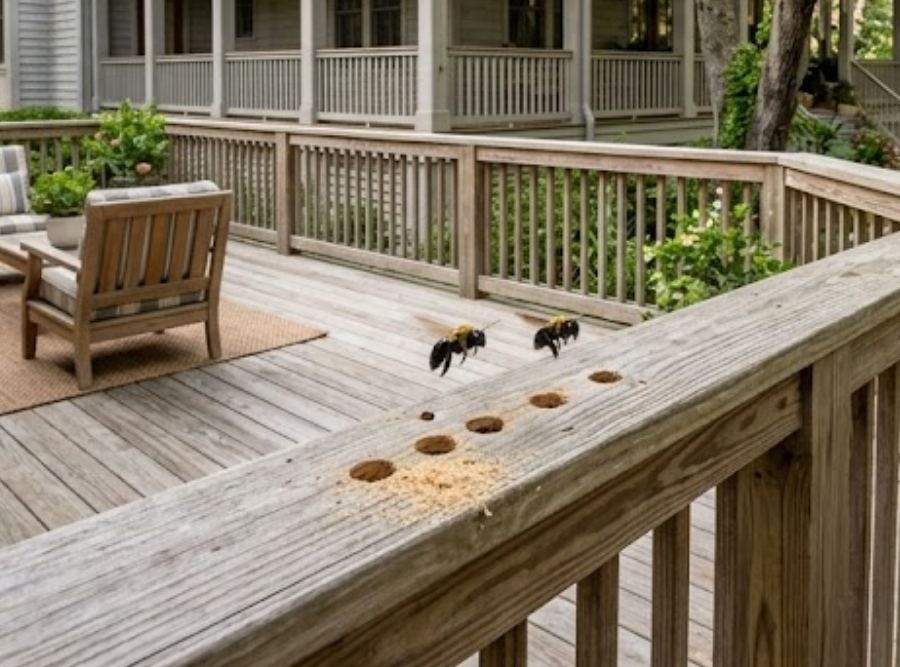
Carpenter bees return to the same spot because existing nesting galleries are easier to reuse or expand than starting a new tunnel in fresh wood. On Hilton Head Island, warm springs, coastal humidity, weathered finishes, and exposed cedar, pine, cypress, or pressure-treated lumber make decks and porches especially attractive year after year.
The first warm stretch of spring arrives, and suddenly the large black bees are back around the same railing, beam, or porch ceiling they targeted last year. Homeowners often notice them hovering in place, circling the deck, and disappearing into perfectly round holes in the wood. It can feel as though the bees remember the exact location, and in a practical sense, they often do return to areas where suitable nesting galleries already exist.
Carpenter bees are solitary wood-nesting bees that excavate tunnels in exterior lumber rather than building large communal hives. Female carpenter bees create round entrance holes and then turn within the wood to form longer galleries where they place pollen provisions and lay eggs. When an old gallery is still usable, reoccupying or expanding it requires less effort than boring into an entirely new section of wood.
That reuse behavior is one of the main reasons the damage appears in the same place each spring. A deck railing with one old entrance hole may attract returning adults, newly emerged bees from the previous season, or other carpenter bees investigating an established nesting area. If those galleries remain untreated and unsealed, the same board can be used repeatedly while new tunnels appear nearby.
In Hilton Head’s coastal climate, that cycle can continue for years. Mild winters allow spring activity to begin early, while humidity, rain, salt air, and strong sunlight gradually weaken paint and stain. As protective coatings deteriorate, more bare or softened wood becomes available, making the same deck increasingly attractive over time.
Carpenter Bees Do Not Eat the Wood
One of the most common misconceptions is that carpenter bees consume wood in the way termites do. They do not use the wood as food. Instead, they remove small amounts of material while excavating a tunnel that will serve as a nesting gallery.
The fine sawdust or yellowish shavings collecting beneath a railing are the discarded wood fibers produced during excavation. Fresh material beneath a round hole is one of the clearest signs that a gallery is active or being expanded. Homeowners may also notice scraping sounds from within a board when a female is actively boring.
This distinction matters because carpenter bee damage develops differently from termite damage. Termites feed within wood and can remain largely hidden, while carpenter bees create visible entrance holes leading to galleries that follow the grain. A single carpenter bee hole may initially appear cosmetic, but repeated reuse and expansion can create more extensive internal tunneling than the outside of the board suggests.
The bees are usually not trying to destroy the deck. They are responding to wood that offers the right combination of softness, shelter, warmth, and protection. Once they find a suitable section, returning to it is more efficient than searching for another nesting site.
Why Hilton Head Decks Are Especially Attractive
Hilton Head Island provides a long carpenter bee season because spring temperatures rise early and remain favorable for extended periods. Decks, pergolas, docks, porch ceilings, fascia boards, exposed beams, and wooden railings offer protected surfaces where bees can nest above ground. Homes near wooded areas may experience even more activity because mature trees and nearby natural habitat support larger local bee populations.
The island’s humidity and rainfall also affect exterior wood finishes. A deck that was thoroughly stained several years ago may now have thin, weathered areas along railings, board edges, and sunny elevations. Strong ultraviolet exposure can break down coatings, while moisture causes wood to swell and contract, gradually exposing softer fibers.
South- and west-facing deck sections often receive especially heavy sunlight, making the finish deteriorate faster. At the same time, porch ceilings, joists, and sheltered railings stay protected from direct rain, providing dry places for galleries to remain usable. This combination of weathered surfaces and protected nesting locations helps explain why bees may repeatedly target one specific corner rather than the entire deck.
Cedar, pine, cypress, and weathered pressure-treated lumber are common targets. Pressure treatment may help protect wood from decay and certain insects, but it does not make lumber immune to carpenter bee excavation. If the surface is unpainted, rough, or weathered, bees may still find it suitable.
Why Old Holes Attract New Activity
An existing entrance hole is more than leftover damage. It is a direct route into a gallery that may already provide the space and protection needed for another nesting season. Female carpenter bees may clean out old galleries, extend them farther into the wood, or create additional brood chambers branching from the original tunnel.
Newly emerged adults may also return to the general area where they developed. That means a deck that supported one generation can become a recurring nesting location in later seasons. Over time, several bees may use the same section of railing, even though carpenter bees do not form a single hive like honeybees.
This is where a small problem can become a repetitive one. One or two holes remain open after spring activity ends, the wood finish continues to deteriorate, and the galleries are available again when temperatures rise the following year. New holes then appear close to the old ones because the surrounding wood offers the same favorable conditions.
Simply covering the visible opening does not necessarily solve the problem. If larvae or adult bees remain inside, sealing an active gallery can trap them or encourage them to chew another exit. The gallery must be properly evaluated and addressed before the entrance is sealed and the surface refinished.
Are Carpenter Bees Aggressive?
The large bees hovering around decks often make homeowners and guests uncomfortable, especially when a bee seems to fly directly toward someone’s face. In many cases, the hovering bee is a male defending territory near a nesting area. Male carpenter bees cannot sting, although their behavior can appear confrontational.
Female carpenter bees can sting, but they are generally less aggressive and are more focused on entering and maintaining their galleries. Stings are uncommon unless a female is handled, trapped, or directly threatened. Even so, nesting activity around stairways, doors, seating areas, and heavily used decks should be taken seriously, particularly when someone in the household has a severe bee-sting allergy.
Accurate identification is important because carpenter bees are often confused with bumblebees. Bumblebees typically have fuzzier abdomens and usually nest in cavities or underground rather than drilling clean round holes into wood. Treating every large bee as a carpenter bee can lead to unnecessary control attempts and may harm beneficial pollinators that are not damaging the structure.
When Carpenter Bee Damage Becomes More Than Cosmetic
A small number of isolated holes may not immediately weaken a substantial deck board, but repeated nesting over several years can create longer internal galleries and growing clusters of damage. Railings, handrails, fascia, and thinner trim members deserve particular attention because they have less wood available to absorb repeated tunneling. The exterior may show only several round openings while the internal galleries extend much farther along the grain.
Woodpeckers often make the damage worse. They can hear or detect carpenter bee larvae within the galleries and peck into the wood to reach them. Their excavation enlarges small entrance holes into torn, irregular cavities and may damage a broader area than the bees themselves.
Open galleries can also allow moisture into exposed wood. On Hilton Head, where humidity and rain already place stress on exterior materials, water entering through holes can contribute to staining, finish failure, and decay around damaged areas. Once rot and woodpecker activity are added to repeated bee tunneling, repair can progress from simple sealing and refinishing to replacing railings, fascia, trim, or deck boards.
This is why recurring activity should not be dismissed simply because the deck still feels solid. Early treatment and repair are usually easier than correcting years of gallery expansion, water intrusion, and secondary damage.
What Homeowners Often Try First—and Why the Bees Keep Coming Back
By the time most homeowners call us, they’ve usually tried something on their own. They may have sprayed a carpenter bee flying around the deck, stuffed wood putty into a hole, hung decorative bee traps, or painted over the damaged area. While these efforts are understandable, they often address only the visible symptom instead of the nesting behavior that causes the problem to return each spring.
One of the most common mistakes is sealing an active gallery before confirming it is no longer occupied. If larvae or developing bees remain inside, closing the entrance doesn’t eliminate the nesting site. In some cases, the bee simply creates another exit through nearby wood, while in others the untreated gallery remains attractive to future carpenter bees once the repair deteriorates. Timing matters just as much as the repair itself.
Another frequent issue is treating only the holes that are easy to see. Carpenter bees rarely limit themselves to a single board. If one railing has become attractive because its protective finish has weathered away, nearby fascia boards, porch ceilings, pergolas, stair stringers, or exposed beams may also be suitable nesting sites. Focusing on one entrance hole while ignoring surrounding wood often allows the cycle to continue just a few feet away.
We’ve also seen homeowners replace damaged boards without addressing the conditions that attracted carpenter bees in the first place. A brand-new piece of unfinished lumber installed beside several older nesting galleries may quickly become the next target if it isn’t properly protected and the surrounding activity isn’t addressed.
What We Commonly Find During Carpenter Bee Inspections
One of the advantages of inspecting carpenter bee activity over many years is recognizing patterns that aren’t always obvious from the ground. While homeowners understandably focus on the visible holes, our inspections usually begin by evaluating the condition of the entire structure rather than just the damaged board.
Older decks in neighborhoods such as Sea Pines, Forest Beach, Port Royal Plantation, and Spanish Wells often show the same progression. Protective stains have weathered after years of exposure to sun, humidity, and rain. Railings begin developing isolated entrance holes that are reused over multiple seasons. Eventually, new galleries appear nearby as the available nesting space expands. By the time the homeowner notices fresh sawdust each spring, several generations of carpenter bees may already have used the same section of wood.
Vacation homes present another recurring pattern. Because many second homes remain unoccupied during portions of the spring, carpenter bee activity often continues unnoticed during the most active nesting period. By the time owners return, fresh galleries have already been established and woodpeckers may have enlarged some of the older holes while searching for larvae.
Waterfront properties also deserve special attention. Docks, pergolas, gazebos, elevated decks, and exposed porch structures near Broad Creek, Skull Creek, or Calibogue Sound experience constant weather exposure. Salt air, humidity, and ultraviolet light gradually shorten the life of stains and clear sealers, allowing exposed wood to become increasingly attractive unless maintenance keeps pace with the coastal environment.
These inspections reinforce an important lesson: carpenter bee problems are rarely caused by one isolated hole. They’re usually the result of wood condition, environmental exposure, previous nesting activity, and delayed maintenance working together over several seasons.
How to Reduce the Chances of Carpenter Bees Returning Next Spring
The most successful long-term strategy focuses on making the wood less attractive before the next nesting season begins. Carpenter bees prefer surfaces that are easier to excavate, so maintaining exterior finishes is one of the most valuable preventive steps homeowners can take. A properly maintained painted or stained surface provides far less opportunity than weathered, unfinished wood that has been exposed for several years.
Old galleries should also be addressed correctly once they’re no longer active. Proper repair helps eliminate convenient nesting entrances while preventing moisture from entering damaged wood. Simply leaving last year’s holes open gives future carpenter bees an invitation to inspect the same location when spring temperatures rise again.
Routine inspections are equally important, especially in Hilton Head’s climate where carpenter bee activity begins earlier than many homeowners expect. Checking railings, deck boards, porch ceilings, fascia boards, pergolas, and exposed beams before nesting season allows developing problems to be identified while they’re still small. Finding one or two fresh holes is far easier to manage than discovering dozens of galleries after another successful breeding season.
Homeowners should also pay attention to nearby wood structures, not just the primary deck. Fences, docks, shutters, trim boards, gazebos, and decorative wooden features can all become nesting sites. Carpenter bees don’t recognize property boundaries or individual structures. If suitable wood exists nearby, they’ll continue searching for locations that offer shelter and easy excavation.
Why Prevention Is More Effective Than Repeated Repairs
One of the biggest differences between temporary relief and long-term control is understanding that carpenter bee management isn’t just about removing the bees you see today. It’s about interrupting the annual nesting cycle before another generation develops.
If galleries remain untreated, protective finishes continue deteriorating, and attractive nesting sites stay available, the same seasonal activity often repeats itself. Homeowners repair visible holes every spring, only to discover fresh sawdust and new entrance holes the following year. Over time, maintenance becomes more expensive because repairs expand beyond cosmetic patching into board replacement, refinishing, and correcting woodpecker damage.
That’s why our approach has always emphasized understanding why carpenter bees selected a particular location instead of simply reacting to the insects themselves. Every deck is different. Construction materials, exposure to sunlight, nearby trees, humidity, previous repairs, and the overall condition of the wood all influence future nesting behavior. Identifying those factors allows treatment and prevention to work together rather than relying on repeated seasonal repairs.
We’ve also learned that many homeowners wait until the damage becomes obvious before taking action. Unfortunately, carpenter bees don’t wait. By the time numerous holes appear across a deck, the galleries may have been expanding quietly for several years. Addressing the problem earlier usually preserves more of the original wood while reducing long-term maintenance costs.
Protecting Your Hilton Head Deck From Another Season of Carpenter Bee Damage
Carpenter bees return to the same spots because those existing galleries provide an easier place to nest than starting over somewhere new. Combined with Hilton Head’s mild winters, warm springs, coastal humidity, and weathered exterior wood, those old nesting sites often become part of a repeating annual cycle. The good news is that recurring carpenter bee activity isn’t something homeowners simply have to accept.
Maintaining protective finishes, repairing inactive galleries correctly, monitoring wood each spring, and addressing activity before another generation develops can significantly reduce future nesting. When damage has become widespread or the same areas continue attracting carpenter bees year after year, a professional inspection can help identify why the activity keeps returning and recommend the most effective long-term approach for your specific property.
At Mr. Pest Control, we believe successful carpenter bee management goes beyond treating individual holes. By understanding the condition of the wood, the surrounding environment, and the bees’ natural nesting behavior, we help homeowners protect their decks, porches, docks, and outdoor living spaces from repeated seasonal damage while preserving the beauty of their homes for years to come.

Joe Duncan is the owner of Mr. Pest Control, a family-owned pest control company that has served Bluffton, SC and the surrounding Lowcountry since 1955. As the third generation to run the business, Joe and his crew provide residential and commercial pest control, termite control, mosquito treatment, and bed bug services throughout Beaufort and Jasper County, SC. He’s built the company’s reputation on straightforward, no-nonsense service backed by a money-back guarantee.