
For most Bluffton homes, a termite bond is worth it, because subterranean termites are active in the Lowcountry for much of the year and standard homeowners insurance generally does not pay for termite damage. How much a bond is worth depends on what it actually covers. That means whether it includes repairs or only retreatment, whether it covers Formosan termites, and how often your home is inspected.
The renewal notice usually arrives on a day when nothing looks wrong. There are no swarmers on the windowsill, no soft spots in the floor, and no mud tubes anyone has noticed. So the question feels reasonable: why keep paying every year to protect a house that does not have termites? Many Bluffton homeowners ask us exactly that, especially after years of quiet renewals, after buying a newer home that was pretreated, or after a seller handed them a bond at closing that nobody explained.
The honest answer is that a termite bond is not about whether you have termites today. It is about who catches them, who treats them, and who pays when they show up, because termite pressure in Beaufort County is steady enough that most homes will be tested at some point. This article explains what a termite bond is and is not, why Bluffton homes face real termite pressure, how to judge whether a specific bond is worth its price, and the mistakes that leave homeowners paying for protection they do not actually have.
What a Termite Bond Actually Is, and What It Is Not
A termite bond is a service agreement between a homeowner and a licensed pest control company. Some people call it termite insurance, but it is a contract, not an insurance policy, and its protection is only as good as its wording. In general, the company agrees to inspect the home on a set schedule and to take specific action if termites are found, in exchange for an initial treatment and an annual renewal fee. What that specific action is depends entirely on the type of agreement.
Most bonds fall into one of two categories. A retreatment-only agreement obligates the company to treat again if termites return, at no extra charge, but leaves the cost of repairing any damage to the homeowner. A repair-and-retreatment agreement also covers qualifying termite damage repairs, usually up to a stated limit and subject to exclusions. The two can look similar on a renewal invoice and behave very differently when termites actually show up. This is where homeowners often misunderstand what they are paying for, so before you ask whether a bond is worth it, ask which kind you have.
This distinction matters more because homeowners insurance usually does not step in. Standard homeowners policies generally treat termite damage as a maintenance issue and exclude it, which means the bond is often the only financial protection a Bluffton homeowner has against termite repairs. Read the exclusions closely as well. Common ones include pre-existing damage that was documented before coverage began, damage tied to moisture conditions the owner was asked to correct, areas the inspector could not access, and termite species the contract does not name.
That last exclusion is especially important on the coast. South Carolina requires termite contracts to state whether Formosan subterranean termites are covered and whether that coverage includes retreatment, repairs, or both. Because Formosan termites have been documented in parts of Beaufort County, a Bluffton homeowner should check that line on the contract before assuming the house is fully protected.
Why Termite Risk Is Real for Bluffton Homes
Subterranean termites live in the soil and reach the wood in a house through concealed routes, often working inside walls, sill plates, and floor framing for a long time before anyone sees evidence. In the Lowcountry, the soil rarely gets cold enough to fully shut colonies down, so foraging continues for much of the year, not just during the spring swarm season most people associate with termites. That long active season is the basic reason termite protection matters more here than in many other parts of the country.
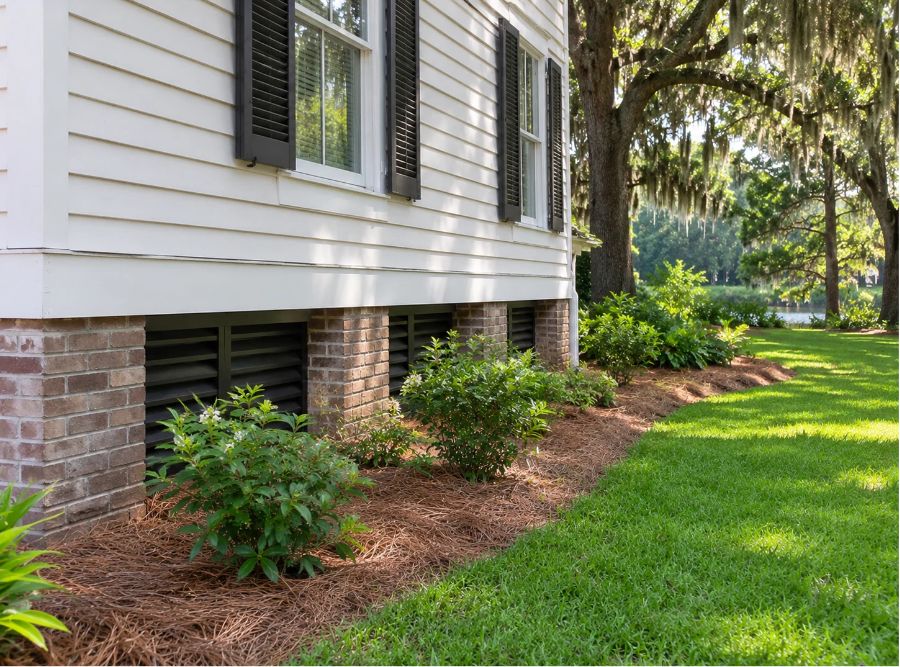
The type of house changes where the risk shows up, not whether it exists. In Old Town Bluffton and along May River Road, raised homes on piers and crawl spaces give termites direct access to framing, and crawl spaces with damaged or missing vapor barriers stay damp enough to support both termites and wood decay. In slab-built neighborhoods such as Hampton Lake, Shell Hall, or the New Riverside corridor, many owners assume concrete keeps termites out. It does not. Termites can enter through expansion joints, slab edges, cracks, and the gaps around plumbing and utility penetrations, and those entry points are usually hidden behind finished walls and flooring.
Modern landscaping adds to the pressure. Irrigation systems that wet the foundation, deep mulch beds piled against siding, and wood steps or deck posts that touch the soil all create the damp, sheltered conditions subterranean termites look for. Wooded lots in communities like Rose Hill and Belfair put active colonies close to the house to begin with. Formosan termites raise the stakes further. Clemson Extension has documented them on Hilton Head Island and in other parts of Beaufort County, and their colonies can grow far larger than native species.
New construction deserves its own note. Many newer Bluffton homes were pretreated for termites during construction, and that pretreatment usually comes with an initial warranty for a limited period. It is real protection, but it does not last forever, and the renewal terms after the initial period are often narrower than buyers expect. A homeowner who assumes the builder took care of termites for good may not realize the warranty has quietly lapsed.
How to Tell Whether a Termite Bond Is Worth It for Your Home
The annual fee is the least useful number to compare. Two Bluffton bonds can differ by a modest amount per year and differ enormously in what happens when termites are found. Start with the coverage type. A repair-and-retreatment agreement costs more because the company takes on part of the financial risk of damage. A retreatment-only agreement can still be valuable, since it pays for professional treatment and regular inspection, but you carry the repair risk yourself. Neither is automatically the better deal. What matters is that you know which one you are paying for.
Next, look at what the agreement requires of both sides. How often is the home inspected, and does that inspection include the crawl space, the attic where accessible, and the slab perimeter? Are Formosan termites named? Is there a cap on repair coverage, and what conditions could void it, such as unrepaired leaks, wood-to-soil contact, or renovations you did not report? Can the bond transfer to a buyer if you sell, and does that require an inspection or a fee? Clear answers to these questions tell you far more than the price does.
Some homes get more value from a bond than others. Older homes on crawl spaces, homes on wooded or heavily irrigated lots, homes that have had termites before, and seasonal or rental properties where problems can go unnoticed for months are strong candidates for ongoing protection with regular inspections. So is any home you plan to sell in the next few years, since an active, documented bond with a clean history can make a sale go more smoothly. A newer slab home within its builder warranty period may need less right now. Even then, the useful question is what happens when that warranty ends, not whether termites can reach the house.
There is also a practical cost to letting a bond lapse. Reinstating coverage later often requires a new inspection and sometimes a new treatment, so canceling to save one year’s renewal can end up costing more than it saves. If you are considering dropping a bond, get the reinstatement terms in writing first.
Termite Bond Mistakes Bluffton Homeowners Make
The most common mistake is assuming every bond includes repairs. Homeowners often learn the difference only after termites are found and the company explains that the contract covers retreatment and nothing more. A close second is treating a clean CL-100 Wood Infestation Report as proof of protection. A CL-100 documents what an inspector could see on one day for a real estate transaction. It is not a warranty, and it does not mean concealed termites are absent or that the home is covered going forward.
Buyers often assume a seller’s bond moves to them automatically at closing. Some transfer easily, some require an inspection or a fee, and some cannot be transferred at all. If the listing says the house is bonded, ask for the actual contract, the treatment history, and written confirmation from the company that the agreement will transfer and on what terms. A bond that is only described in a listing is not something you can rely on.
Other mistakes happen long after the paperwork is signed. Adding a patio, a room, or a new irrigation line can disturb treated soil or bait stations, and many agreements require you to notify the company about that kind of work. Piling fresh mulch against the foundation year after year can cover the inspection zone and hide mud tubes. Spraying a store-bought insecticide on visible mud tubes kills a few termites, destroys the evidence an inspector needs, and does nothing about the colony. Letting a known moisture problem go, such as a leaking crawl space pipe or a gutter that empties against the foundation, can give the company grounds to deny coverage under the contract’s conditions.
The last mistake is never reading the renewal. Coverage terms, prices, and Formosan provisions can change over time. Long-term customers often renew automatically for years without noticing that their agreement no longer matches what they thought they had.
How Mr. Pest Control Approaches Termite Protection in Bluffton
Any termite agreement is only as good as the inspection behind it, so that is where we start. On crawl space homes, we get underneath and check piers, sill plates, and floor joists for mud tubes, damaged wood, and the moisture conditions that keep termite pressure high. On slab homes, we check the foundation perimeter, garage slab edges, expansion joints, and utility penetrations, which are where termites usually get in when they cannot reach wood directly from the soil. We document what we find and explain it before we talk about treatment.
Treatment depends on how the home is built and what we find. Liquid termiticide applied to the soil around the foundation creates a continuous treated zone. On slab homes that means drilling and injecting along the foundation edge, and on crawl space homes it means trenching around piers and the perimeter. Bait stations placed around the property intercept foraging workers and carry the active ingredient back to the colony. Some homes benefit from both approaches. Afterward, we provide documentation of what was found, what was applied, and where.
The treatment is the start of protection, not the whole of it. We set up a monitoring schedule suited to the property and check treated zones and bait stations at regular intervals, so renewed activity is caught early instead of discovered during a renovation or a home sale. Before you sign or renew anything, we walk you through exactly what our termite coverage includes and what it does not. With four generations of pest control experience behind our family-operated business, we would rather you understand your protection than assume it.
Termite Bond Questions We Hear in Bluffton
Does homeowners insurance cover termite damage in South Carolina?
Usually not. Standard homeowners policies generally exclude termite damage because insurers treat it as a preventable maintenance issue, not a sudden accident. That is why a termite bond, especially one with repair coverage, is often the only source of financial protection against termite repairs. If you are unsure, ask your insurance agent to point to the exact language in your policy.
Do I need a termite bond if my Bluffton home is on a concrete slab?
A slab foundation changes how termites get in, but it does not keep them out. Subterranean termites can travel through expansion joints, cracks, and gaps around plumbing and utility penetrations, often behind walls and flooring where damage stays hidden longer than it would in an open crawl space. Slab homes still benefit from regular professional inspection and an active treatment program.
Does a termite bond transfer when I sell my house?
It depends on the contract. Some bonds transfer to the buyer with a simple request, others require an inspection or a transfer fee, and some do not transfer at all. If you plan to sell, keep the contract, renewal records, and treatment history together, and ask your termite company in advance what the buyer will need.
What happens if my termite bond lapses?
A lapse ends the company’s obligations under the agreement, including scheduled inspections and any retreatment or repair coverage. It does not mean termites will move in, but it does mean nobody is watching for them. Getting coverage back often requires a new inspection and sometimes a new treatment, so check reinstatement terms before you let a renewal date pass.
Making the Termite Bond Decision With the Contract in Hand
A termite bond is worth it in Bluffton when you know what it does. The value comes from regular professional inspection, treatment when termites return, and, in the right agreement, help with repair costs that homeowners insurance will not pay. A bond you have never read, cannot transfer, or that leaves out Formosan termites is worth much less than its renewal fee suggests. Before you renew, cancel, or buy a house that comes with one, put the actual contract on the table and ask the questions in this article. If you would like a second set of eyes on your home or your current coverage, call Mr. Pest Control at (843) 295-4555 for a free quote, and our family-run team will explain what we see and what we would recommend.
