
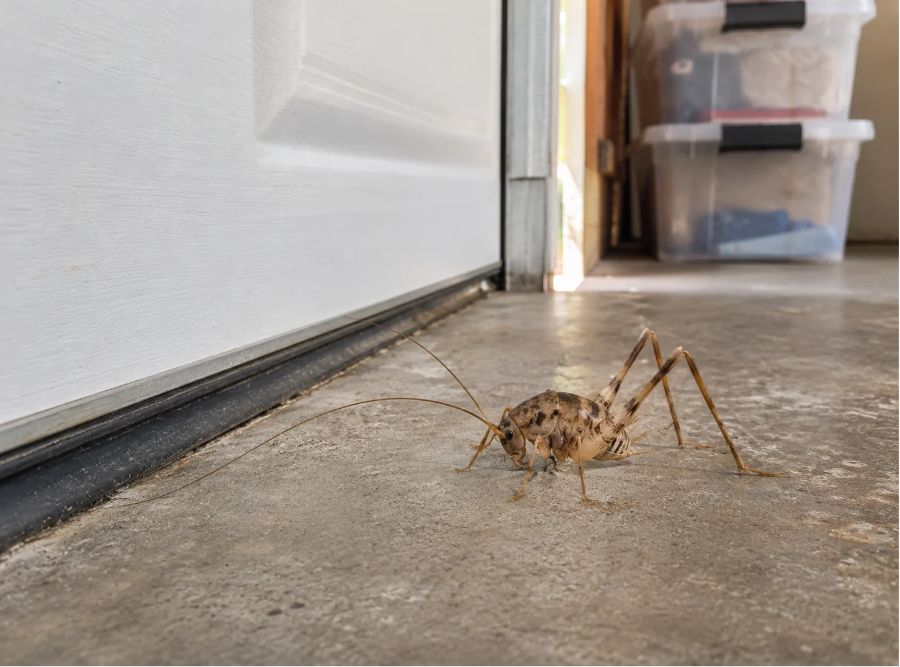
Camel crickets end up in Bluffton garages because they look for dark, damp, sheltered places, and a garage with worn door seals, stored cardboard, and moisture nearby gives them exactly that. They are harmless nuisance pests that do not bite, sting, or damage wood. Keeping them out depends on reducing moisture, sealing entry points, and clearing hiding spots, not on spraying the ones you see.
You reach for a box of holiday decorations, and something brown with long, spindly legs launches itself toward your face. A second one leaps from behind the trash can. They look like spiders, they jump like grasshoppers, and they never seem to make a sound. For many Bluffton homeowners, that is the first meeting with camel crickets, also called cave crickets or spider crickets, and it usually happens in the garage.
The good news is that camel crickets are far more startling than they are harmful. The more useful news is that they are telling you something about the garage. Repeated sightings usually point to moisture, gaps around the garage door, or nearby outdoor habitat that keeps sending them inside. This article explains how to identify camel crickets, why Lowcountry garages attract them, why spraying them rarely solves the problem, and what actually keeps them out.
What Camel Crickets Are, and What They Are Not
Camel crickets are wingless insects with a humped back, very long antennae, and oversized hind legs built for jumping. Most are tan to brown, often with a mottled or banded look, and they can be large enough to be unsettling. Unlike the field crickets you hear on summer nights, camel crickets do not chirp, which is why many homeowners find a garage full of them without ever having heard one. Some species are native to South Carolina, and an introduced species, the greenhouse camel cricket, is also commonly found around homes.
The most common mix-up is with spiders. Camel crickets have six legs, not eight, and they are insects, not arachnids. Their reputation for jumping at people is also a misunderstanding. When startled, a camel cricket jumps to escape, and because it does not see well, that jump sometimes happens to be in your direction. It is not attacking. Camel crickets are not venomous, have no stinger, and are not known to bite people.
They are also not mole crickets, which burrow through soil and can damage lawns, and they are not related to termites. Camel crickets do not eat structural wood. In large numbers over long periods, they may chew on stored paper, cardboard, or fabric, and dead insects and droppings can build up in neglected corners. Their real significance is as a signal. A steady supply of camel crickets usually means the garage, or the ground next to it, is damp and sheltered enough to suit them.
Why Bluffton Garages Attract Camel Crickets
Outdoors, camel crickets live under logs, leaf litter, pine straw, and dense ground cover, anywhere that stays dark and moist. A garage offers a similar shelter, especially one that is not air-conditioned. Bluffton’s humid climate keeps unconditioned garages damp much of the year, and stacks of cardboard boxes, stored lawn equipment, bags of potting soil, and cluttered corners give the crickets plenty of places to hide during the day. Weather plays a part too. Heavy rain can flood their outdoor shelters and push them toward buildings, and long hot, dry stretches can send them looking for cooler, more humid spots. Both happen regularly in the Lowcountry.
The way in is usually the garage door itself. Bottom seals wear out with Bluffton’s heat, sun, and daily use, and the corners where the door meets the frame often leave gaps a cricket can walk through. Other common entry points include gaps at the garage slab edge, utility and plumbing penetrations, worn thresholds on side doors, and, in some homes, connections to a crawl space. A garage door that stays open while the car is unloaded or yard work is underway also lets a few in at a time.
The property around the garage matters as much as the garage. Deep pine straw beds and shrubs against the garage wall, downspouts that empty right next to the slab, and irrigation that keeps the foundation soil wet create damp habitat just outside the door. Wooded lots in communities like Rose Hill add leaf litter and shade. In Old Town, older detached garages and outbuildings often have more settlement gaps and weathered seals. Newer homes in Hampton Lake or the New Riverside area are not immune either, since door-corner gaps and landscape moisture can support camel crickets on a house that is only a few years old.
This is where homeowners often misunderstand what they are seeing. Camel crickets in the garage do not automatically mean there is a plumbing leak or a structural problem. They do mean conditions are favorable, and the best way to find out why is to look for the specific moisture source and entry point.
Why Spraying Alone Doesn’t Keep Them Away
The usual first move is a can of insect spray along the garage walls. It kills the crickets it hits, and for a few days the garage seems quiet. Then they come back, because spraying does nothing about the damp habitat outside or the gap under the door that lets the next group in. Unless the entry points and moisture are dealt with, treating only what you can see becomes a routine with no end.
Some DIY approaches create new problems. Foggers and total-release aerosols are a poor fit for a garage. They coat stored belongings, pet supplies, and tools, they do not reach crickets hiding inside boxes, and some carry fire and inhalation hazards around pilot lights, chargers, and stored fuel. Products labeled for outdoor use only should not be used inside a garage, and any product used near children’s belongings, pet food, or stored food has to be applied exactly as the label directs.
Well-meant exclusion can backfire too. Sealing crawl-space vents to keep crickets out, without first checking how that crawl space is meant to be ventilated or dried, can trap moisture and create a bigger problem than the crickets ever were. Sticky traps are useful for showing where crickets travel and for catching small numbers, but they will not fix the reason they keep arriving. The pattern is the same in each case. Camel crickets are a moisture and access problem first, and a pest problem second.
What Actually Keeps Camel Crickets Out of the Garage
Start with the door. Look at the garage door from inside with the lights off on a sunny afternoon. If you can see daylight along the bottom seal or at the corners, crickets can get in there. Replacing a worn bottom seal and adding or adjusting the side and top weatherstripping is one of the most effective changes you can make, and it also helps with other pests, dust, and wind-driven rain. Seal gaps where pipes and wires pass through the walls, and check the threshold on any side door.
Next, deal with moisture. Make sure downspouts carry water well away from the garage and that the ground slopes away from the slab. Adjust sprinkler heads so they do not soak the garage wall. Pull pine straw and mulch back a few inches from the foundation, and trim shrubs so air and sunlight reach the ground along the garage. Inside, look for anything that keeps the space damp, such as a slow leak at a utility sink or water heater, condensation around a laundry hookup, or rainwater coming in under the door. In a garage that stays humid, a dehumidifier can help.
Then take away the hiding places. Move stored items off the floor and onto shelving, and switch from cardboard boxes, which absorb moisture and give crickets cover, to sealed plastic bins. Clear the clutter from corners and along the walls. Place sticky traps along the base of the walls and behind stored items to catch the remaining crickets and see where activity is concentrated. That tells you where to look for the entry point.
If you have done all of this and still see camel crickets regularly, or if they are turning up in the laundry room or kitchen, it is time for a professional inspection. A targeted exterior treatment applied according to the label can help once the conditions are addressed, but it works best as one part of the fix, not the whole fix.
How Mr. Pest Control Handles Camel Crickets in Bluffton
When we look at a camel cricket problem, the crickets are the least interesting part. We want to know where they are coming from and why the garage suits them. That means checking the garage door seals and corners, the slab edge, utility penetrations, and any side doors, then walking the outside of the garage to look at mulch depth, downspouts, irrigation, and shaded beds against the wall. If the home has a crawl space connected to or near the garage, we look at whether moisture there could be feeding the activity.
From there, we explain what we found in plain terms. Some fixes are simple things a homeowner can handle, such as a new bottom seal, moving downspout extensions, or storing items in sealed bins. Some, like a leak or a drainage problem, may call for a plumber or another contractor, and we will tell you that directly instead of treating around a moisture problem that will keep bringing crickets back. Where treatment makes sense, we apply it to the specific areas where crickets live and enter, following label directions and taking care around stored belongings, pets, and children’s things.
For homes on recurring residential pest service, the garage and the ground around it are part of the regular perimeter program, which helps keep camel crickets and other occasional invaders from building up again. With four generations of pest control experience, our family-operated team has found that the most lasting fixes in the Lowcountry come from correcting the conditions pests depend on, not just treating the pests themselves.
Camel Cricket Questions We Hear in Bluffton
Are camel crickets dangerous to kids or pets?
No. Camel crickets are not venomous, have no stinger, and are not known to bite people. The biggest risk is being startled by a sudden jump in a dark garage, which can lead to a stumble near stairs or stored equipment. In practice, the greater safety concern is usually the products people use against them, so any insecticide in a garage should be used strictly according to its label and kept away from children’s and pets’ belongings.
Do camel crickets mean I have a moisture problem?
Not necessarily, but they do mean the area is damp and sheltered enough to suit them. In a Bluffton garage, that can come from normal Lowcountry humidity, wet landscaping against the wall, a downspout emptying next to the slab, or, sometimes, an actual leak. If camel crickets keep showing up in large numbers, it is worth checking for a specific moisture source rather than assuming humidity is the whole explanation.
Why don’t camel crickets chirp?
Camel crickets lack the wing structures that field crickets and house crickets rub together to make their chirping sound. That is why homeowners can have a garage full of them without ever hearing anything. If you hear chirping in the garage, you may have a different kind of cricket, or a mix of both.
Will camel crickets spread into the rest of my house?
They sometimes wander from an attached garage into a laundry room, mudroom, or kitchen, especially through the door between the garage and the house. Air-conditioned living spaces are usually too dry for them to stay long, so indoor sightings tend to be strays from a garage or crawl-space population. Regular indoor sightings are a good reason to have the source found and dealt with.
Fixing the Garage, Not Just the Crickets
Camel crickets are startling, but they are mostly a sign of conditions. A damp, cluttered garage with a worn door seal and wet landscaping against the wall will keep attracting them no matter how often you spray. Seal the door, dry out the area, move belongings into sealed bins, and most Bluffton garages become far less inviting within a season. If you have already done the obvious fixes and the crickets keep coming back, or they are showing up inside the house, call Mr. Pest Control at (843) 295-4555 for a free quote. Our family-run team will help you find where they are getting in and what is drawing them there.
