
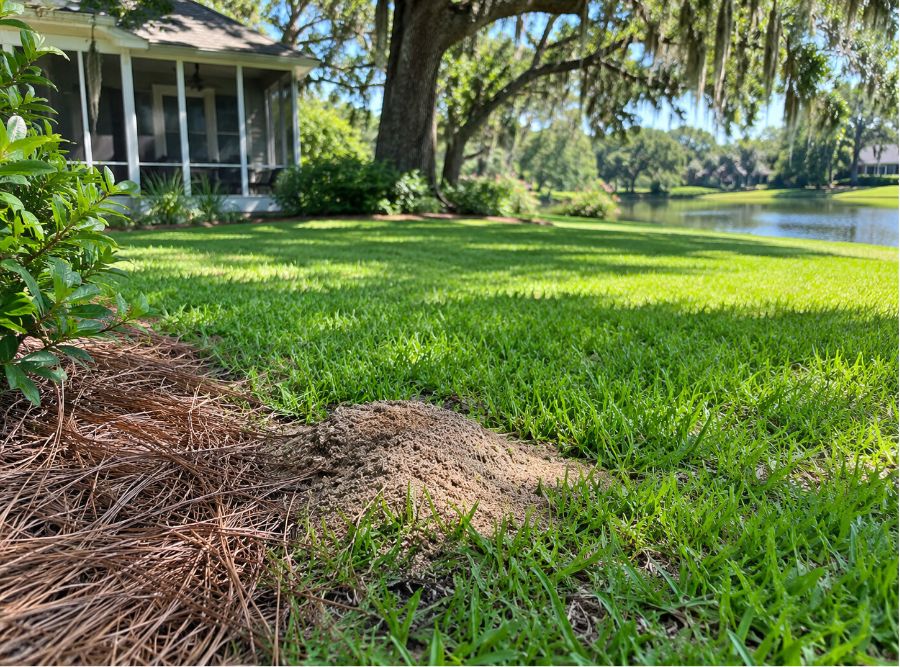
To get fire ants under control in a Bluffton yard, you have to kill the colonies, not just the ants you can see. That means a two-step approach of spreading fire ant bait across the whole yard and then treating individual mounds, followed by monitoring so new colonies are caught early. No outdoor treatment keeps fire ants away permanently, but a planned, seasonal program can keep your lawn usable year after year.
It usually starts with one mound by the driveway. You pour something on it, the mound goes quiet, and two weeks later three new ones show up along the fence line and in the flower bed. Many Bluffton homeowners go through this cycle every summer, and it leaves them convinced fire ants simply cannot be beaten. The real problem is that most treatments aimed at visible mounds never reach the part of the colony that matters.
Red imported fire ants are an invasive species throughout coastal South Carolina, and Bluffton’s long warm season, sandy soils, irrigated lawns, and steady new construction give them plenty of room to settle in. The good news is that they can be managed reliably once you understand how a colony survives and spreads. This article explains why fire ants keep coming back, which common fixes fail and why, and what a treatment plan that actually holds looks like for a Bluffton property.
Why Fire Ants Keep Coming Back in Bluffton Yards
The mound you see is only the top of the nest. A fire ant colony keeps its queen or queens, eggs, larvae, and pupae in chambers that can run well below the surface and spread out beyond the visible soil pile. When a treatment kills the workers near the top but the queen survives, the colony keeps producing new ants and often rebuilds nearby. That is why a mound that seemed dead can reappear a few feet away, and why homeowners reasonably conclude that the ants moved. In most cases they did not move. The same colony survived and resurfaced.
Many fire ant populations in the Southeast also have multiple queens in a single colony. Multiple-queen colonies can spread by budding, where workers carry a queen and brood off to start a new nest close by, which produces a cluster of mounds that all belong to related colonies. A yard can also be colonized by winged queens that fly in after mating flights, which tend to follow rain in warm weather. Treating one mound does nothing about the colonies next door, the ones in the HOA common area, or the queens that land in your lawn next spring.
Local conditions make this worse in specific ways. In newer Bluffton developments such as the New Riverside corridor, graded soil, fresh sod, and new landscape beds give founding queens open, sunny ground with little competition. In established communities around Hampton Lake, Hampton Hall, or Sun City, irrigated lawns, lagoon banks, and shared green spaces mean colonies on one lot can quickly spill onto the next. After Bluffton’s afternoon thunderstorms, wet soil is easy to dig, so mounds that were flat and quiet suddenly look fresh and active. That burst of activity after rain often makes homeowners think a treatment failed when the colony was simply rebuilding its mound.
The Fixes That Don’t Last, and Why
Most of the remedies homeowners try first work on the ants they can see and miss the colony underneath. Boiling water kills the ants it reaches, but it often doesn’t get deep enough to kill the queen. It also kills the grass around the mound and puts the person pouring it at real risk of burns. Hardware store contact sprays act the same way. Workers on the surface die, the mound looks finished, and the colony below keeps going. Mowing over mounds, flooding them with a hose, or spreading vinegar, cinnamon, coffee grounds, or diatomaceous earth disturbs the nest or drives ants away for a while, but none of these reliably kills a colony.
This is where homeowners often misunderstand what they are seeing. A mound that goes quiet after a spray is not proof the colony is dead, and a new mound a few weeks later is not always proof the product failed. It may be the same colony rebuilding, a separate colony that was there all along, or a new queen that moved in from somewhere else. Telling these apart matters, because the right next step is different for each.
Bait products cause their own mistakes. Fire ant bait only works when foraging workers pick it up and carry it back to feed the colony, including the queen. Bait spread on wet grass, right before one of Bluffton’s summer storms, or just before the irrigation runs gets soaked and ignored. Bait from an opened bag that sat in a hot garage for a season can go stale and stop attracting ants. Piling bait on top of a mound, or using more than the label calls for, does not speed anything up and can backfire. Many baits also take days or weeks to work, so homeowners who expect results overnight often reapply too soon or switch to a spray that kills the very workers who would have carried the bait to the queen.
One more mistake deserves a direct warning. Gasoline, bleach, and other household chemicals poured into mounds are dangerous to people, pets, and soil, and they are not an approved way to treat fire ants. Any product used on your lawn should be labeled for fire ants and applied exactly as the label directs.
The Two-Step Approach That Controls Fire Ants in Bluffton
Clemson Extension and other Southeastern extension programs recommend a two-step method for yards with more than a few mounds. The first step is a broadcast bait application over the whole treatable area, not just the visible mounds. Foraging workers carry the bait back to their colonies, including colonies whose mounds you have not found yet. The second step is a targeted treatment of individual mounds that are in high-traffic spots, such as next to a patio, a play area, a dog run, or the front walk, where you cannot wait for bait to work. Combining the two deals with the whole yard and gives faster relief in the places that matter most.
Timing decides whether bait works. In the Lowcountry, spring and fall are usually the best windows for broadcast baiting, because the ants are foraging steadily and the weather is milder. During the hottest part of summer, fire ants tend to forage in the cooler morning and evening hours, so bait is best applied later in the day. Bait should go on when the grass and soil are dry, with no rain or irrigation expected for the period the product label specifies. A simple way to check whether ants are foraging is to leave a small piece of greasy food, such as a potato chip, near a mound and see whether ants find it within about half an hour.
Patience is the hardest part. Depending on the active ingredient, bait can take anywhere from several days to several weeks to work through a colony. During that time you may still see workers, and that is normal. Mound treatments in high-use areas fill that gap. Follow-up matters as much as the first application. Because new queens keep arriving and neighboring colonies keep foraging, a yard that is clean in October can have new mounds by May. A seasonal schedule that rebaits on time and spot-treats new activity is what turns fire ant control from a summer-long fight into routine yard care.
For homeowners who prefer to handle this themselves, the key points are simple: choose products labeled for fire ants, read the entire label, store bait sealed and use it while fresh, and never treat when rain is coming. Larger properties, yards next to water, and lawns where children and pets play every day are where professional planning usually pays off.
Fire Ants Around Kids, Pets, Lagoons, and Shared Spaces
Fire ants are a problem because of how they defend a nest. When a mound is disturbed, large numbers of workers swarm out and sting repeatedly, and the stings usually become itchy white pustules within a day or so. Children playing barefoot, dogs sniffing along the fence, and anyone kneeling in a flower bed are the most likely to step into a colony. For most people the stings are painful but not dangerous. A small number of people have serious allergic reactions, and trouble breathing, swelling of the face or throat, dizziness, or a reaction that spreads well beyond the sting sites needs emergency medical care right away.
That risk is why mound location matters as much as mound count. A colony at the back edge of a wooded lot is a lower priority than one beside a swing set, a dog run, or the walkway guests use. When we plan treatment on a Bluffton property, the areas where people and pets spend time come first. We also discuss precautions with the homeowner, such as how long to keep children and pets off a treated area, because those instructions depend on the specific product being used.
Water changes the plan. Many Bluffton neighborhoods are built around lagoons, retention ponds, and drainage swales, and some yards back onto marsh. Pesticide labels often restrict how close a product can be applied to water, and runoff from a heavy afternoon storm can carry product where it does not belong. Treating near water takes product selection and application methods that respect those restrictions. This is one of the main reasons a quick do-it-yourself broadcast is not always the right call for waterfront and lagoon-front lots.
Shared spaces add one more factor. In HOA communities, colonies in common areas, along walking paths, or on an untreated lot next door keep sending ants back into treated yards. Treating your own lawn still helps, but realistic expectations matter. If the surrounding ground stays infested, follow-up visits and monitoring are what keep your yard usable, and in some communities the most lasting fix is coordinated treatment through the association.
How Mr. Pest Control Handles Fire Ants in Bluffton
We start by walking the property, not by spraying it. The goal is to find where the colonies are, how many there appear to be, which ones sit in high-traffic areas, and what is around the yard that could feed reinfestation, such as an untreated common area, a lagoon bank, or a neighboring wooded lot. We also ask what has already been tried. Previous products and timing often explain why the mounds keep returning, and they affect what we recommend next.
From there, we build the treatment around the two-step approach and the property itself: area-wide baiting timed to when the ants are foraging, targeted treatment for the colonies that cannot wait, and product choices that account for children, pets, and nearby water. Because fire ants are a recurring Lowcountry pest and not a one-time event, the plan includes follow-up. Seasonal monitoring catches new colonies while they are small and before they reach the patio or the play area.
Fire ant control fits naturally into our lawn pest program, which also covers grubs, chinch bugs, and other insects that damage Lowcountry turf, and it can be bundled with recurring household pest service. That means one local, family-operated team with four generations of pest control experience looks after both the bugs trying to get into the house and the ones taking over the yard. When you call, you reach a real person who can tell you what to expect and when.
Fire Ant Questions We Hear From Bluffton Homeowners
Can fire ants be eliminated from a yard permanently?
Not from an open outdoor yard. Fire ants are established throughout coastal South Carolina, and new queens fly in from surrounding land every warm season, so no treatment can promise a yard that never sees another mound. What is realistic is eliminating the colonies you have now and keeping new ones from becoming established through seasonal baiting and monitoring. For most homeowners, that means a lawn where fire ants are rare and caught early, which is the practical meaning of getting rid of them for good.
Do fire ants go away in winter in Bluffton?
No. Bluffton’s mild winters slow fire ants down, but they do not kill the colonies. During cool weather the ants stay deeper in the soil and build fewer fresh mounds, so a yard can look clear in January and fill with mounds again in spring. That seasonal lull is why fall treatment and early spring monitoring matter so much.
Why do new fire ant mounds show up after it rains?
Rain softens the soil and can flood the upper chambers of a nest, so the ants quickly rebuild and move soil to the surface. Mounds that were flat and hard to see suddenly look fresh, even though the colony was there the whole time. Warm, rainy weather is also when mating flights often happen, which can bring new queens into the yard. A burst of mounds after a storm usually reflects that activity, not proof that every previous treatment failed.
Is fire ant treatment safe for dogs and kids?
It depends on the product and how it is applied, which is why no honest pest control company will call any treatment harmless in every situation. Bait products, granular treatments, and liquid drenches each carry their own label directions on when people and pets can return to treated areas. We explain those precautions for the specific products used on your property, and we plan treatment around the places where your children and pets spend the most time.
Taking Your Bluffton Yard Back From Fire Ants
The main lesson is that fire ants are a colony problem, not a mound problem. Killing what you can see brings a few quiet weeks. Reaching the colony with well-timed bait, treating the mounds that threaten the spots your family uses, and watching for new arrivals is what keeps a Bluffton lawn usable through spring, summer, and fall. If you have treated the same yard every summer and the mounds keep coming back, or if you have small children, pets, or a lagoon behind the house, a property-specific plan is the next step. Call Mr. Pest Control at (843) 295-4555 for a free quote, and a real person from our family-run team will walk you through what we would recommend for your yard.
